
Explore the science of wayfinding and learn how researchers study navigation in complex indoor spaces. Discover how eye tracking, GSR, VR, and UX research can reveal what people notice, where wayfinding breaks down, and how signage and environments can better guide people to their destinations.
Table of Contents
Finding your way through a building seems like an outwardly simple task. You look for a sign, follow an arrow, maybe follow an architectural cue and arrive where you need to be.
In practice, indoor wayfinding involves a constant series of small decisions.
Imagine arriving at an unfamiliar hospital. You need to find a specific department. You enter through the main doors and immediately need to decide where to look. Is there a sign above you? A directory on the wall? A colored route on the floor? Should you continue straight, or stop and ask someone?

For researchers, these small decisions make indoor wayfinding a rich behavioral problem. Studying whether someone eventually reaches their destination is useful, but it only tells part of the story.
A wayfinding study can also investigate how people navigate, what information they look for, which signs they notice, where they hesitate, and why they sometimes make a wrong turn.
What Is Wayfinding?
Wayfinding is the process people use to understand where they are, decide where they need to go, and navigate from one place to another.
In indoor environments, a wayfinding system can include much more than directional signs. Maps, room numbers, symbols, colors, digital displays, architectural features, landmarks, lighting, and the layout of the building itself can all help people understand a space.
This is why wayfinding design crosses architecture, interior design, graphic design, UX, and behavioral research.
Good indoor wayfinding brings these elements together so that people can find and understand the information they need, particularly when they are unfamiliar with the environment.
How Does Indoor Wayfinding Work?
People do not necessarily navigate a building by following one continuous set of directions. Instead, navigation often happens as a sequence of smaller decisions.
A person identifies where they want to go, searches for useful information, interprets what they find, chooses a direction, moves through the space, and then reassesses.
Need for direction → Visual search → Information found → Interpretation → Decision → Movement → Reassessment
For researchers, this provides a useful framework. If someone takes a wrong turn, where did the process fail? Did they miss the relevant information? Did they see the sign but misunderstand it? Or did something else in the environment influence their decision?
This distinction matters in complex indoor environments such as hospitals, airports, stations, universities, museums, and shopping centers.
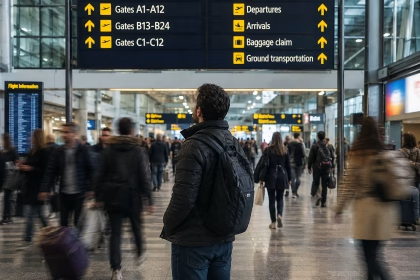
Two participants might both successfully find Gate B27. One walks directly there. The other stops four times, walks past a turn, doubles back, and checks several signs before arriving.
Both succeeded. Their wayfinding experiences were very different.
Study the Journey, Not Just the Destination
A wayfinding study can easily become a study of signage. Signs are important, but they are only one part of how people navigate.
People may use overhead signs, maps, room numbers, architectural features, landmarks, or digital screens. They might follow other people or look through an entrance to understand where it leads.
Researchers should therefore define success beyond simply reaching the correct destination. Journey time, route choice, wrong turns, stops, hesitation, backtracking, and requests for help can all reveal how well an environment supports navigation.
Decision points are especially valuable. Junctions, elevators, entrances, staircases, and large open areas force people to decide what to do next.
What happens at these points? Do people immediately find the information they need? Do they stop and search? Do they look back after making a turn to confirm that they made the right choice?
These behaviors can reveal uncertainty even when the participant ultimately chooses the correct route.
People Change Their Minds Along the Way
Real journeys are also rarely as simple as moving directly from point A to point B.
Airports are a good example. A traveler may intend to reach their gate, but that does not mean they will take the most direct route. They may get hungry and look for somewhere to eat. They might want to buy a gift, find a restroom, refill a water bottle, or locate a comfortable seat before boarding.
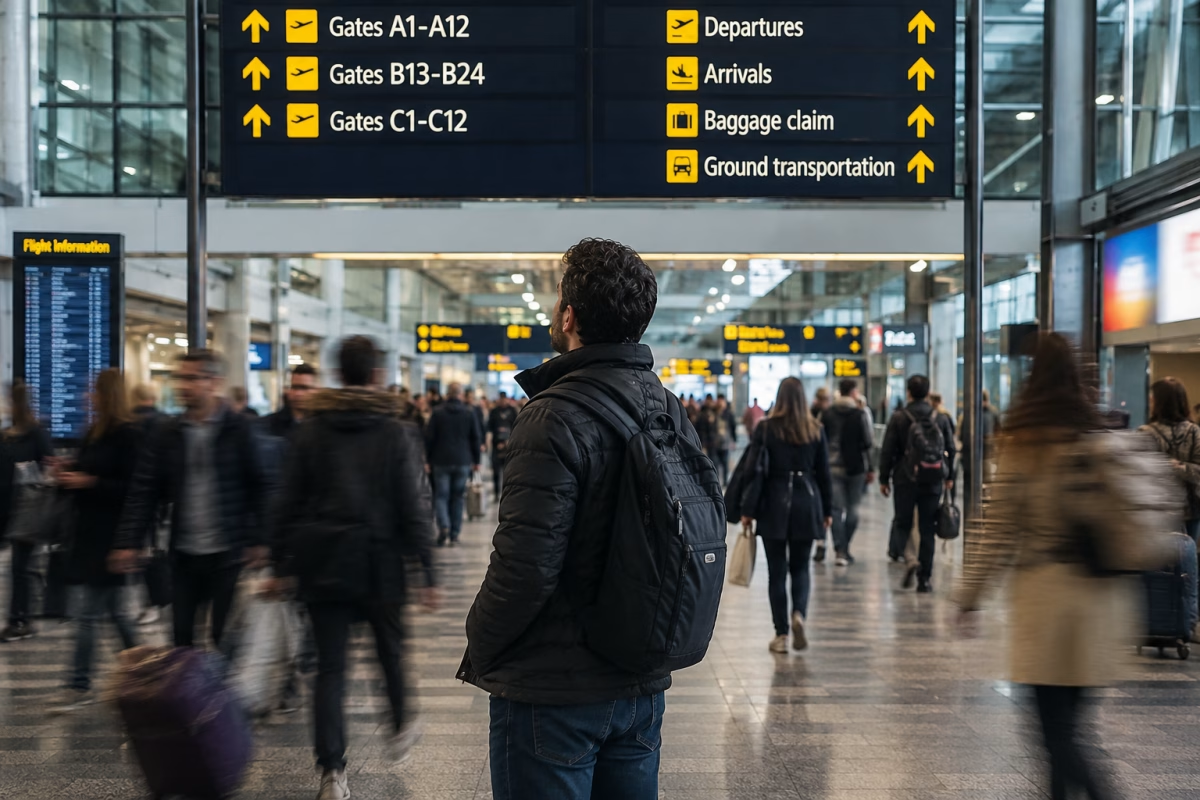
Each new goal changes what information matters.
Similar shifts happen elsewhere. A hospital visitor may decide to find a café or pharmacy before returning to their original route. A museum visitor may suddenly need a restroom or want to find a particular exhibit.
Good wayfinding should support these changing priorities. People need to be able to leave their original route, find a new destination, understand where they are, and then continue without having to start again.
This makes reorientation an interesting consideration for researchers. Instead of testing only fixed routes from A to B, a study can introduce secondary goals or allow participants to make natural choices along the way.
When someone’s goal changes, where do they look for new information? How quickly can they find it? And how easily can they return to their original journey?
What Makes Good Wayfinding Signage?
Wayfinding signage includes the visual signs used to help people understand and navigate an environment. These can include directional signs, identification signs, directories, maps, room markers, and digital displays.
Good signage is not simply signage that is easy to read in isolation. It has to work as part of the environment around it.
A few principles provide useful starting points:
- Put information where decisions happen. Directional information should appear before junctions and other points where people need to choose a route.
- Create a clear visual hierarchy. Destinations, arrows, and essential information should be easy to identify while scanning.
- Keep the system consistent. Terminology, colors, symbols, and naming conventions should remain consistent throughout the journey.
- Reduce competition for attention. More information does not always mean better wayfinding. Advertisements, screens, and other signs can make important guidance harder to find.
- Provide reassurance. Confirmation after an important turn can help people know that they are still heading in the right direction.
Architecture can also do some of this work. Distinctive entrances, colors, objects, sightlines, or other landmarks can help people understand where they are without requiring another sign.
For researchers, however, these principles should be treated as hypotheses to test rather than guarantees of good wayfinding.
A sign that looks obvious to someone who already knows the building may be almost invisible to a first-time visitor.
What Do People Actually Notice?
This is where eye tracking can add an important layer to wayfinding research.
Indoor environments are rarely visually quiet. An airport sign may compete with departure screens, shops, advertisements, security information, architecture, and other travelers. A hospital directory may sit among posters, doors, notices, and medical information.
A sign being present does not mean that it was seen.
Researchers can therefore examine how people visually search an environment. How quickly do they find relevant information? Which signs attract attention? What do they look at instead? And what happens immediately before a navigation decision?
This also helps distinguish between two very different problems.
If participants do not look at the relevant sign, there may be an issue with visibility, placement, or competing visual information. If they look directly at it but still hesitate or choose the wrong route, the problem may instead involve comprehension.
That difference is difficult to establish by simply asking someone whether the signage was clear after the journey.
Using iMotions to Study Indoor Wayfinding
Wayfinding involves attention, movement, decision-making, and emotional response. It can also involve switching between physical spaces and digital tools such as maps, kiosks, and information screens.
This makes it well suited to a multimodal research approach.
With iMotions, researchers can combine different measures depending on the questions they want their study to answer.
Eye Tracking Glasses for Real-World Wayfinding
Eye tracking glasses allow participants to move naturally through an airport, hospital, station, museum, or other indoor environment while their visual attention is recorded.
Researchers can investigate whether participants notice directional signs, how quickly they find them, which elements compete for attention, and what they look at before making a navigation decision.
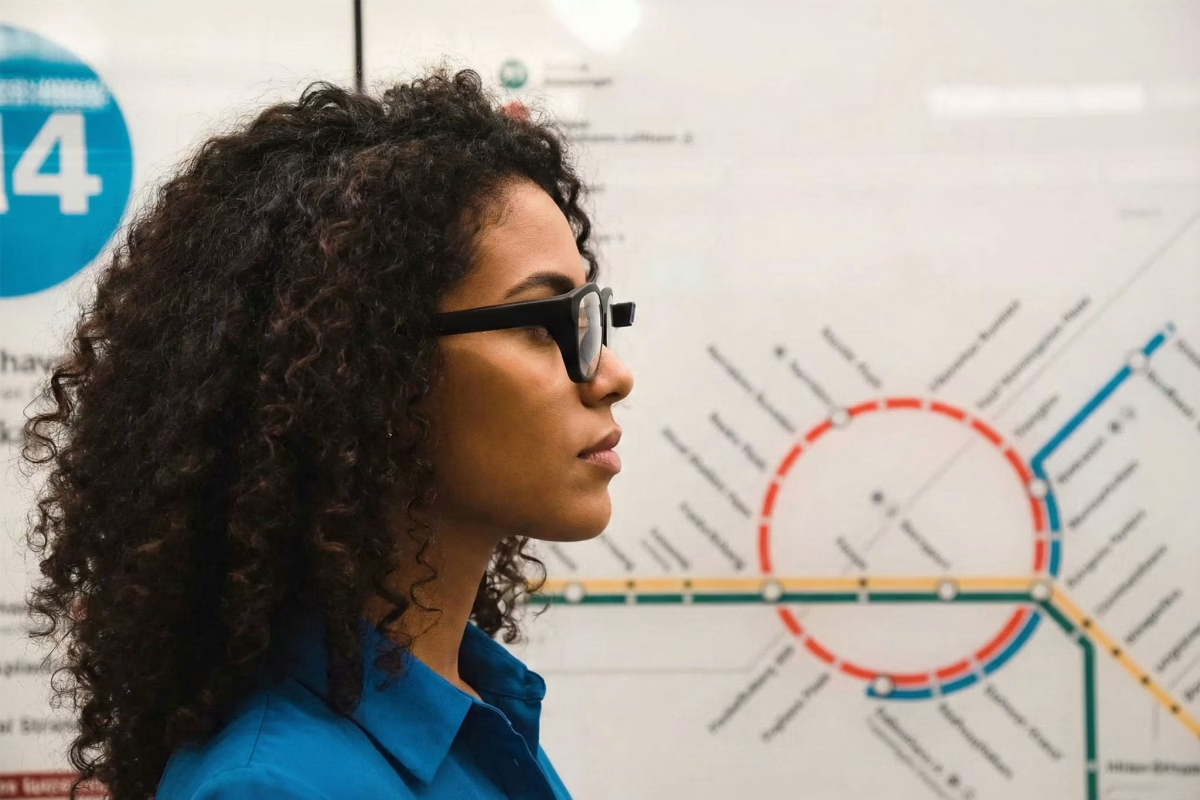
This becomes particularly useful when connected to behavior.
If someone stops at a junction or takes a wrong turn, researchers can examine the moments leading up to it. Did they miss the relevant sign? Did they inspect several competing signs? Did they see the correct information but still choose another route?
Areas of Interest, or AOIs, can also be used to quantify attention to signs, maps, displays, landmarks, and other important features of the environment.
Eye tracking therefore helps distinguish between information being available and information actually being noticed and used.
GSR for Physiological Arousal
Wayfinding can also involve moments of uncertainty, particularly when people lose confidence in where they are going.
Galvanic skin response, or GSR, measures changes in physiological arousal. When synchronized with other measures, it can help researchers identify moments where arousal increases during a journey.
GSR alone cannot tell researchers that someone is stressed or frustrated. Context matters.
However, an increase in arousal that occurs alongside repeated visual searching, hesitation, a wrong turn, or a participant reporting frustration can provide useful evidence that a particular part of the journey deserves closer investigation.
This may be especially relevant in environments such as hospitals and airports, where navigation can take place alongside time pressure and uncertainty.
VR for Wayfinding in Simulated Spaces
Wayfinding research does not always require a finished building.
Virtual reality can allow researchers to test proposed environments before they are built or changed. Different layouts, signs, colors, landmarks, and information systems can be compared while keeping other elements controlled.
Eye tracking in VR can then reveal what participants notice while navigating the simulated environment.
Researchers could compare alternative sign placements, investigate whether a landmark improves orientation, or test two versions of a proposed hospital layout before physical changes are made.
Changing a virtual corridor is considerably easier than rebuilding a real one.
Test the UX of Digital Wayfinding
Modern indoor wayfinding increasingly happens on screens as well as signs.
Airports, hospitals, shopping centers, and universities may use interactive directories, digital maps, kiosks, and other interfaces to help visitors choose and locate destinations.
These systems create their own UX research questions.
Can someone quickly understand where they are on a map? Can they find the destination they need? Is it clear which floor they should go to? Do they notice the option to generate directions? Can they understand the route quickly enough to use it once they walk away?
Eye tracking can show where users search for information on the interface. Interaction data can reveal taps, selections, errors, and task completion. Surveys can capture how easy or difficult people felt the system was to use.
Importantly, researchers can also study the transition between digital and physical wayfinding.
A participant might successfully locate a restaurant on an airport directory but become confused as soon as they walk away from the screen. The interface worked, but the complete wayfinding journey did not.
Bring Attention, Behavior, and Experience Together
The strongest wayfinding studies can connect these different parts of the journey.
Eye tracking can show what someone looked at. Behavioral measures can show what they did next. GSR can identify changes in physiological arousal. Surveys and interviews can capture what participants thought and felt about the experience.
Imagine a participant approaching a large junction in a hospital. Their gaze moves between several signs. They stop walking, look back towards the corridor they came from, and show an increase in physiological arousal. After the task, they report that this was the point where they became unsure of the route.
None of those measures alone tells the complete story.
Together, they provide a clearer picture of where the wayfinding experience became difficult and what was happening when it did.
Participant selection matters here too. Someone who works in a building every day no longer navigates it like a first-time visitor. Studies should recruit participants who reflect the people the system is intended to help and consider factors such as familiarity, age, language, and accessibility where relevant.
How Do You Know if a Wayfinding System Actually Works?
There are plenty of guidelines for creating good wayfinding systems. The harder question is whether people actually notice, understand, and use them as intended.
That is ultimately what a wayfinding study should answer.
Where did participants stop? Which signs did they notice? Which did they miss? What did they look at instead? What happened before a wrong turn? Did they understand the information they saw? And when their priorities changed, could they easily reorient themselves?
Using iMotions, researchers can bring these different signals together and study wayfinding as an unfolding human experience rather than a simple pass-or-fail navigation task.
The question then becomes more useful than “Did they get there?”
It becomes “How did they get there, what helped them along the way, and where did the environment get in their way?”
References and Further Reading
- Arthur, P., & Passini, R. (1992). Wayfinding: People, Signs, and Architecture. McGraw-Hill.
- Passini, R. (1992). Wayfinding in Architecture. Van Nostrand Reinhold.
- Cognitive Research: Principles and Implications. (2024). Wayfinding in pairs: comparing the planning and navigation performance of dyads and individuals in a real-world environment. https://cognitiveresearchjournal.springeropen.com/articles/10.1186/s41235-024-00563-9
- Frontiers in Psychology. (2020). Wayfinding in Interior Environments: An Integrative Review. https://www.frontiersin.org/journals/psychology/articles/10.3389/fpsyg.2020.549628/full
- arXiv. (2023). A data-driven approach to predict decision point choice during normal and evacuation wayfinding in multi-story buildings. https://arxiv.org/pdf/2308.03511
- CUNY Manifold. Environmental Factors That Influence People’s Wayfinding in Indoor Environments: An Integrative Literature Review. https://cuny.manifoldapp.org/read/environmental-factors-that-influence-people-s-wayfinding-in-indoor-environments-an-integrative-literature-review
- ResearchGate. (2020). A Gamification-Based Approach on Indoor Wayfinding Research. https://www.researchgate.net/publication/342561978_A_Gamification-Based_Approach_on_Indoor_Wayfinding_Research
- PMC. Autonomous indoor wayfinding for individuals with cognitive impairments. https://pmc.ncbi.nlm.nih.gov/articles/PMC2946295/
- bioRxiv. (2021). Identifying Uncertainty States during Wayfinding in Indoor Environments: An EEG Classification Study. https://www.biorxiv.org/content/10.1101/2021.12.14.453704.full.pdf
- arXiv. Augmented Reality Indoor Wayfinding in Hospital Environments: An Empirical Study on Navigation Efficiency, User Experience, and Cognitive Load. https://arxiv.org/pdf/2601.00001
- Journal of Asian Architecture and Building Engineering. (2025). Design mechanisms of airport visual guidance systems on passenger wayfinding performance. https://www.tandfonline.com/doi/full/10.1080/13467581.2025.2589544
- ResearchGate. (2022). From Visual Behavior to Signage Design: A Wayfinding Experiment with Eye-Tracking in Satellite Terminal of PVG Airport. https://www.researchgate.net/publication/354763265_From_Visual_Behavior_to_Signage_Design_A_Wayfinding_Experiment_with_Eye-Tracking_in_Satellite_Terminal_of_PVG_Airport
- Taylor & Francis. (2020). Effective wayfinding adaptation in an older National Health Service hospital in the United Kingdom: insights from mobile eye-tracking. https://www.tandfonline.com/doi/full/10.1080/24735132.2020.1729000
- HERD Journal (SAGE). (2022). Wandering Eyes: Using Gaze-Tracking Method to Capture Eye Fixations in Unfamiliar Healthcare Environments. https://journals.sagepub.com/doi/10.1177/19375867211042344
- ET4S. (2013). What Lab Eye Tracking Tells Us About Wayfinding. http://www.spatialeyetracking.org/wp-content/uploads/2013/10/et4s_2013_paper6.pdf
- Tobii. Wayfinding Research: Uncover Spatial Navigation Insights. https://www.tobii.com/solutions/consumer-research-and-user-experience/wayfinding-research
- Tobii. So many signs, so little time — Eye tracking and wayfinding. https://www.tobii.com/blog/so-many-signs-so-little-time
- Modulex. Data-Driven Signage: How Eye-Tracking Technology Helps You Avoid Wayfinding Mistakes. https://modulex.com/blog/how-eye-tracking-technology-helps-you-avoid-wayfinding-mistakes/
- Entro Communications. Wayfinding Signage Design. https://entro.com/wayfinding/
- PubMed. (2020). Electrodermal Activity and Stress Assessment. https://pubmed.ncbi.nlm.nih.gov/33011695/
- iMotions. Galvanic Skin Response (GSR): The Complete Pocket Guide. https://imotions.com/blog/learning/research-fundamentals/galvanic-skin-response/
- arXiv. (2023). Defining, measuring, and modeling passenger’s in-vehicle experience and acceptance of automated vehicles. https://arxiv.org/pdf/2309.10596
- Noldus. What is Galvanic Skin Response? https://noldus.com/blog/what-is-galvanic-skin-response
- Journal of Environmental Psychology. (2025). Pre-occupancy evaluation of wayfinding signage using immersive virtual reality. https://www.sciencedirect.com/science/article/abs/pii/S0142694X25000420
- HAL / IOP Conf. Series. A BIM-based model to study wayfinding signage using virtual reality. https://hal.science/hal-03813473/document
- Journal of Environmental Psychology. (2021). Evaluating the impacts of color, graphics, and architectural features on wayfinding in healthcare settings using EEG data and virtual response testing. https://www.sciencedirect.com/science/article/abs/pii/S0272494421001973