

But It Does Have Small “Buy Levers”
For decades, marketers have searched for a “Buy Button” in the brain. Neuroscience suggests something far more interesting: a complex network of small behavioral levers that shape attention, emotion, memory, and ultimately consumer decisions.
Table of Contents
In 2003, a study on Coke and Pepsi lit up brain-imaging headlines around the world. Participants who knew they were drinking Coke showed more activity in brain regions linked to memory and self-image than those drinking it blind. The finding was genuinely interesting. But somewhere between the journal and the boardroom, it mutated into a much bigger claim: neuroscience could reveal what people really want, bypassing the unreliable business of asking them.
Two decades later, the phrase “buy button” still circulates in marketing decks and vendor pitches, promising a neural shortcut straight to purchase intent. It’s a compelling story. It’s also not how the brain works.

What the research actually points to is messier and, frankly, more useful: not one switch but dozens of small, interacting levers (attention, arousal, memory salience, emotional valence, social context) each nudging behavior a little, none of them decisive alone. A single lever pulled in isolation rarely explains a purchase. A pattern across several, observed over time and triangulated with behavior, tells you something real.
For researchers using physiological and neural tools in consumer research, understanding why the buy-button claim persists, and where it breaks down, matters more than dismissing it outright. Neuromarketing methods are valuable. The overclaiming around them is what damages the field’s credibility.
Why the “Buy Button” Myth Won’t Die
The idea is seductive for a simple reason: it promises certainty. Surveys are self-reported and biased by memory, social desirability, and the simple fact that most purchase decisions aren’t consciously accessible to the person making them. If you could just measure the brain directly, the story goes, you’d skip all that noise and get the truth.

But no single region of the brain governs purchasing decisions. Regions like the nucleus accumbens or ventromedial prefrontal cortex are frequently associated with reward and valuation, but they’re active during countless unrelated experiences too: eating, social bonding, anticipation of almost any kind. Activity in a reward-related area during exposure to an ad tells you the brain registered something salient. It doesn’t tell you the person will buy, how much they’ll pay, or even that they liked what they saw.
The Core Methodological Traps
Reverse inference. This is the technical name for the buy-button fallacy: concluding a specific mental state (desire, preference, delight) from a specific pattern of brain activity, simply because that pattern has been associated with the state before. The logic doesn’t hold up. Brain regions are rarely one-to-one with psychological states, and treating them as such produces confident-sounding conclusions built on shaky inference.
Replication and isolated findings. The problem isn’t simply that neuroscience studies can involve smaller samples. Methods such as fMRI can detect comparatively large effects, making smaller samples appropriate for some research questions. The greater risk comes when an interesting finding from a single study is treated as established knowledge before it has been independently replicated. The same applies across methods: one striking EEG pattern, physiological response, or neural correlate may be worth investigating, but its real value depends on whether the effect is robust, reproducible, and supported by subsequent evidence.
Ecological validity. Physiological and neural methods inevitably capture responses within a particular research context, whether that’s a controlled laboratory, a simulated environment, or a more naturalistic setting. That isn’t inherently a weakness; controlled environments can be extremely useful for isolating effects and reducing noise. The important question is how far the findings can reasonably be generalized. A response measured while someone watches an advertisement in a controlled study may tell us something meaningful about attention or emotional response, but researchers should be cautious about automatically translating that response into claims about purchasing behavior in the considerably more complex environment of everyday life.
Black-box scoring. Commercial neuromarketing has produced no shortage of proprietary indices (“engagement scores,” “purchase intent indices,” “emotional resonance ratings”) built from underlying signals but obscured behind vendor-specific algorithms. Without transparency into how a score is calculated, buyers of these services can’t evaluate whether the number means what it claims to mean, and researchers can’t replicate or challenge it.
Correlation dressed as causation. A physiological response observed during exposure to a marketing stimulus doesn’t necessarily mean the stimulus itself caused that response in the way we assume. Increased arousal, for example, might reflect excitement about the product, but it could also be driven by novelty, surprise, visual intensity, or another element of the stimulus entirely. Establishing that a response occurred is one thing; establishing what caused it, and what that means for subsequent behavior, requires considerably more evidence.
Finding the Buy Levers Instead of the Buy Button
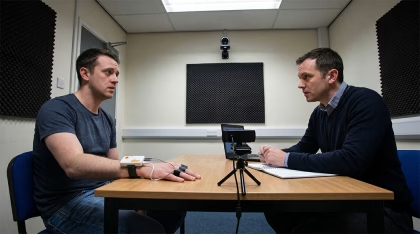
None of this means the tools are the problem. Eye tracking, EEG, facial expression analysis, and GSR all capture real information that self-report alone misses: attention allocation, moment-to-moment arousal, involuntary affective responses. Each is a lever, not a button, a partial, probabilistic contributor to behavior rather than a switch that flips it. The pitfalls above aren’t reasons to abandon these methods; they’re reasons to use them the way good science requires:
- Triangulate, don’t isolate. A single modality is a partial picture. Combining physiological measures with behavioral outcomes and self-report gives convergent evidence instead of a single number treated as truth.
- Match the method to the question. Attention and arousal are measurable with reasonable confidence. Complex constructs like “purchase intent” or “brand love” are not directly observable in a signal and require far more caution in how they’re claimed.
- Report the null results too. A field that only publishes studies where the brain “lit up in the right way” builds a distorted picture of how reliable these signals really are.
- Be explicit about what a metric represents. A score reflecting momentary attentional engagement is a different thing from a score claiming to predict sales lift, even if a slide deck presents them with the same confidence.
The Real Value Proposition
The honest pitch for neuroscience-informed research was never “we found the buy button.” It’s that non-verbal, moment-to-moment physiological data surfaces the small levers self-report can’t reach on its own: an attentional pull toward a product shot, a flicker of arousal at a price reveal, a micro-expression during a value claim. None of these levers decides a purchase by itself. Together, measured carefully and triangulated with behavior, they build a far more honest picture of influence than any single “buy signal” ever could.
Researchers who understand these limitations aren’t weakening the case for using neuroscience methods in consumer research; they’re the ones best positioned to use them credibly, defend their findings under scrutiny, and avoid the overreach that gives the entire field a bad name whenever the next “we cracked the brain’s buy button” story makes the rounds.
References
Ariely, D., & Berns, G. S. (2010). Neuromarketing: the hope and hype of neuroimaging in business. Nature Reviews Neuroscience, 11(4), 284–292.
European Commission. (2025). Guidelines on prohibited artificial intelligence practices established by Regulation (EU) 2024/1689 (AI Act).
McClure, S. M., Li, J., Tomlin, D., Cypert, K. S., Montague, L. M., & Montague, P. R. (2004). Neural correlates of behavioral preference for culturally familiar drinks. Neuron, 44(2), 379–387.
Plassmann, H., Ramsøy, T. Z., & Milosavljevic, M. (2012). Branding the brain: A critical review and outlook. Journal of Consumer Psychology, 22(1), 18–36.
Poldrack, R. A. (2006). Can cognitive processes be inferred from neuroimaging data? Trends in Cognitive Sciences, 10(2), 59–63.
Poldrack, R. A. (2011). Inferring mental states from neuroimaging data: from reverse inference to large-scale decoding. Neuron, 72(5), 692–697.