
Flow is not peak intensity but coordinated efficiency across brain and body. This article explains how flow emerges when challenge and skill align, and how it can be captured through synchronized multimodal data, EEG, ECG, EDA, and eye tracking, revealing stable attention, balanced arousal, and sustained performance.
Table of Contents
What is the “Flow State”?
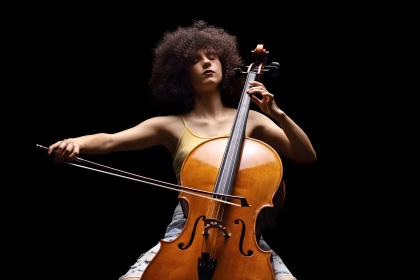
Being in “Flow” is typically described at the level of experience: being “in the zone,” losing track of time, becoming fully absorbed. The concept, introduced by Mihaly Csikszentmihalyi (1975, 1990), has been widely adopted across domains like psychology, sports, education, music, and creative disciplines. However, descriptions are, as we know, not explanations.
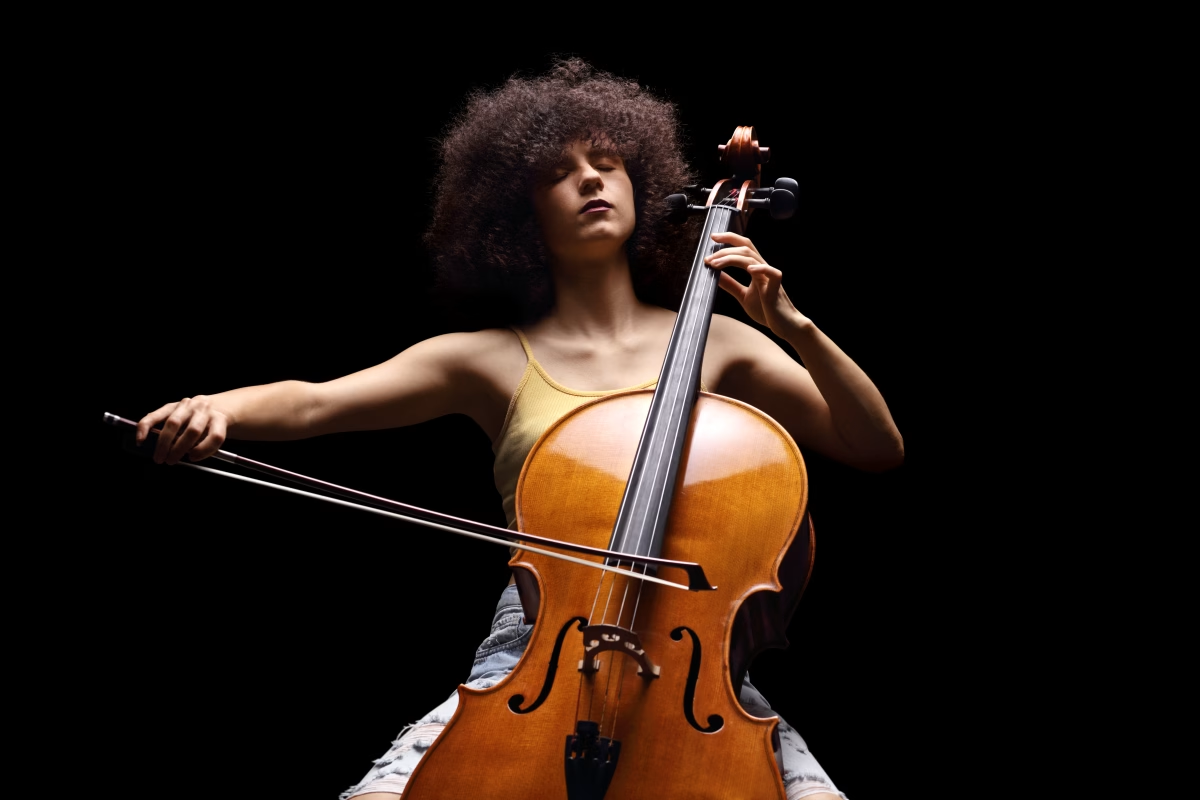
If we move past how flow feels and focus on how it functions, the question becomes more precise, and much more interesting; namely what is happening across the body and brain when this state emerges, and how can that be observed?
Collaborative Efficiency
Immediately, many of us would think of “Flow” as being a thing to measure in intensity. Actually it makes more sense to talk about it as an alignment. Multiple internal systems converge around a single task. The internal systems in question are; cognitive, physiological, and behavioral. When you enter a flow state, your attention narrows, but not through effortful suppression of one’s surroundings, but rather by stabilizing it.
Your body begins to filter out irrelevant inputs with minimal friction, and the task dominates your awareness without causing you significant strain. At the same time, execution shifts and your actions start to feel automatic, even when they are objectively complex (Dietrich, 2004). This system collaboration creates the defining paradox of the flow state: you achieve both high performance through reduced perceived effort.
But how do we get into flow states? Evidence suggests that it has to do with a simple enough equation, which is basically; that if the right skill level and the right level of challenge is present, then flow can be achieved (Csikszentmihalyi, 1975).
This only happens within a narrow regulatory range. If the challenge is too low, the “system” under-activates and attention will most likely start drifting. On the other hand, if the challenge is too high, cognitive load will increase, and so will variability, which will lead to stress responses beginning to dominate.
Flow sits between these states, not exactly as a midpoint, but as a tightly regulated band where activation is high and volatility is low. That distinction is important, because each of these conditions produces different physiological patterns (Alameda et al., 2022).
The Behavioral Data Streams in Flow
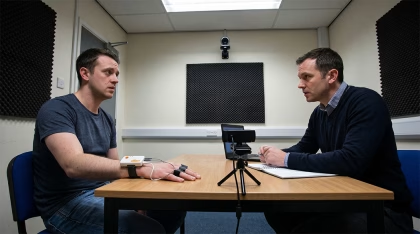
What we see in flow, consistently, is not maximal activation but a state of coordinated efficiency. The system is not working harder, it is simply working in sync. When measured through iMotions, this pattern becomes visible across multiple synchronized modalities.
Neural activity reflects this balance, where cognitive control is sustained without tipping into overload:
EEG: Increased frontal theta activity with moderate frontal and central alpha rhythms, reflecting sustained cognitive control without excessive working memory load. (Katahira et al., 2018).
The same coordinated structure appears in the autonomic nervous system, where activation and regulation coexist rather than compete:
ECG: Elevated but controlled heart rate (Keller et al., 2011).
HRV: Preserved variability, indicating balanced sympathetic and parasympathetic activity (Tozman et al., 2015).
Electrodermal activity follows a similar pattern, avoiding the volatility associated with stress responses:
EDA/GSR: Moderate, sustained arousal without sharp spikes (Nacke & Lindley, 2008).
Behaviorally, this internal synchronization translates into more stable and efficient interaction with the environment. Attention stops searching and begins to lock in:
Eye Tracking: Reduced erratic saccades and more consistent gaze patterns (Harris et al., 2017).
Fixation behavior: Longer, more stable fixations on task-relevant stimuli (Harris et al., 2017).
Taken together, these signals do not represent a single marker of flow, but a converging pattern, one that becomes visible when all modalities are aligned on a shared timeline (Knierim et al., 2024).
Inferring the Flow
This is where measurement must shift from detection to inference. As you can see above, flow is not a variable that can be read directly from a single channel. It is a state that emerges from the interaction of multiple systems over time (Alameda et al., 2022).
To capture it, all signals need to be observed together and, critically, synchronized. Platforms like iMotions Lab make this possible by aligning physiological and behavioral data streams on a shared timeline. Without that alignment, it is difficult to distinguish coincidence from coordination. With a dedicated software solution, patterns will begin to resolve.
A period of stable gaze, moderate arousal, and consistent performance begins to take the shape of something coherent rather than something incidental. A sudden divergence, with a spiking of arousal paired with more erratic attention patterns, signals a transition, not noise to be filtered out. In this way, flow becomes something that can be inferred with increasing confidence.
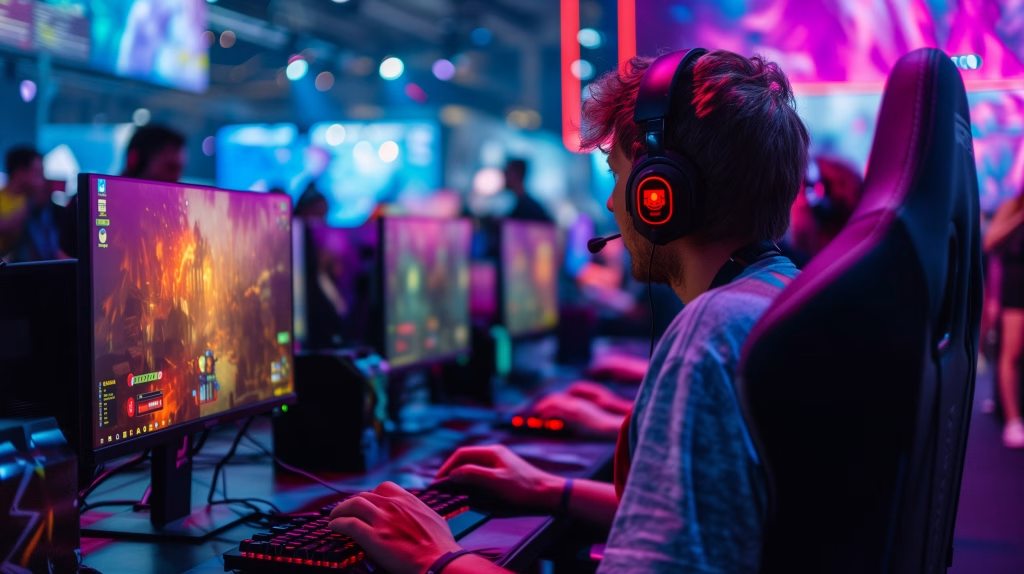
To move beyond inference, it becomes necessary to begin modeling data. By combining multimodal data with self-reported experiences, it becomes possible to train systems to recognize the configurations associated with flow (Knierim et al., 2024). Over time, detection will inevitably start shifting closer to real time. Thus the subjective component does not disappear, but it becomes anchored to observable patterns that can be extrapolated and universalized.
Flow, How We Capture It
So, what happens in flow is not a spike in intensity, but a shift into an internal state of coordination. Cognitive control stabilizes, physiological systems regulate external stimuli, rather than react to it, and attention behavior becomes more consistent and efficient. The system, as a whole, moves into a state where performance can be sustained without unnecessary effort (Csikszentmihalyi, 1990).
It might be helpful to see flow as a compound of reactions, that thus cannot be reduced to a single signal or metric. Rather, it emerges across signals, and so it has to be measured across signals. By combining modalities such as EEG, ECG, EDA, and eye tracking, and aligning them on a shared timeline, it becomes possible to observe how attention, arousal, and cognition evolve together.
What you capture is not “flow” as a standalone variable, but the conditions under which it appears, stabilizes, and breaks.
That distinction is what turns flow from a subjective experience into something that can be analyzed, compared, and ultimately applied.
References
Alameda, C., Sanabria, D., & Ciria, L. F. (2022). The brain in flow: A systematic review on the neural basis of the flow state. Cortex, 154, 348–364. https://doi.org/10.1016/j.cortex.2022.06.005
Csikszentmihalyi, M. (1975). Beyond boredom and anxiety: Experiencing flow in work and play. Jossey-Bass.
Csikszentmihalyi, M. (1990). Flow: The psychology of optimal experience. Harper & Row.
Dietrich, A. (2004). Neurocognitive mechanisms underlying the experience of flow. Consciousness and Cognition, 13(4), 746–761. https://doi.org/10.1016/j.concog.2004.07.002
Harris, D. J., Vine, S. J., & Wilson, M. R. (2017). Flow and quiet eye: The role of attentional control in flow experience. Cognitive Processing, 18(3), 343–347. https://doi.org/10.1007/s10339-017-0794-9
Katahira, K., Yamazaki, Y., Yamaoka, C., Ozaki, H., Nakagawa, S., & Nagata, N. (2018). EEG correlates of the flow state: A combination of increased frontal theta and moderate frontocentral alpha rhythm in the mental arithmetic task. Frontiers in Psychology, 9, Article 300. https://doi.org/10.3389/fpsyg.2018.00300
Keller, J., Bless, H., Blomann, F., & Kleinböhl, D. (2011). Physiological aspects of flow experiences: Skills-demand-compatibility effects on heart rate variability and salivary cortisol. Journal of Experimental Social Psychology, 47(4), 849–852. https://doi.org/10.1016/j.jesp.2011.02.004
Knierim, M. T., Berger, C., & Reali, P. (2024). A framework for neurophysiological experiments on flow states. Communications Psychology, 2, Article 49. https://doi.org/10.1038/s44271-024-00115-3
Nacke, L., & Lindley, C. A. (2008). Flow and immersion in first-person shooters: Measuring the player’s gameplay experience. In Proceedings of the 2008 Conference on Future Play: Research, Play, Share (pp. 81–88). Association for Computing Machinery. https://doi.org/10.1145/1496984.1496998
Tozman, T., Magdas, E. S., MacDougall, H. G., & Vollmeyer, R. (2015). Understanding the psychophysiology of flow: A driving simulator experiment to investigate the relationship between flow and heart rate variability. Computers in Human Behavior, 52, 408–418. https://doi.org/10.1016/j.chb.2015.06.023