


Discover how human behavior research is transforming forensic science. Learn how multimodal platforms like iMotions integrate eye tracking, EEG, GSR, and facial expression analysis to advance deception detection, eyewitness reliability, trauma response understanding, and offender profiling, offering a more rigorous, ethical alternative to the traditional polygraph.
Table of Contents
Forensic science has always been shaped by the tools of its era, from fingerprint analysis in the early 20th century to DNA profiling in the 1980s. In the same way, the addition of human behavior research to criminal investigation, courtroom practice, and offender profiling has the potential to have a big impact.
At the center of this shift is a growing suite of psychophysiological and biometric technologies, most notably our iMotions platform, which enables researchers and practitioners to study human responses with unprecedented precision and overview.
Human Behavior Research: A Scientific Foundation
As readers of our articles will know, human behavior research draws on psychology, neuroscience, and physiology to understand how people think, feel, and act, particularly under stress, deception, fear, or trauma. For forensic purposes, this knowledge is invaluable: namely, understanding how perpetrators, witnesses, and victims behave can inform investigative strategies, improve interview techniques, and strengthen courtroom evidence (Granhag et al., 2015; Vrij, 2008).
Researchers can employ a wide range of measurement instruments to achieve these ends, including physiological signals such as heart rate, galvanic skin response (GSR), facial muscle activity (EMG), and brain activity (EEG). These signals reveal emotional and cognitive states that are difficult to self-report accurately (Meijer et al., 2016). Eye tracking captures attentional focus, while facial expression analysis detects micro-expressions that flash across the face in milliseconds, too fast for the naked eye but not for a calibrated algorithm (Ekman & Friesen, 1969, 1978). Voice analysis allows for the in-depth analysis of answers to gauge emotion and valence during interviews with suspects.
iMotions: A Platform Built To Tackle Complexity
iMotions Lab integrates multiple data streams into a single synchronized environment. The software simultaneously captures and aligns data from eye trackers, EEG headsets, GSR sensors, facial expression videos, ECG monitors, and more, thus allowing researchers to correlate physiological signals across time with pinpoint accuracy.
The Lab platform supports standardized stimuli presentation, precise event marking, and robust data export for statistical analysis. It has been deployed across academic institutions, healthcare settings, marketing research firms, and increasingly, forensic and security-related applications.
Core Forensic Technologies Within iMotions
Eye tracking records gaze direction, fixation duration, and pupil dilation, revealing what a person attends to in a scene, with direct relevance to eyewitness studies and crime scene reconstruction (Biggs et al., 2023; Tung et al., 2025).
Electrodermal activity (EDA/GSR) measures skin conductance changes driven by arousal or stress, providing the physiological foundation that traditional polygraphs rely on, but here embedded in a scientifically validated multimodal framework (National Research Council, 2003; Sen et al., 2025).
Facial expression analysis classifies emotional states in real time from facial muscle movements (Ekman & Friesen, 1978; Matsumoto & Hwang, 2018).
EEG captures neural activity that can index attention, memory recognition, and cognitive conflict (Rosenfeld, 2020).
Forensic Applications of Behavioral Research and iMotions
Deception Detection and Credibility Assessment
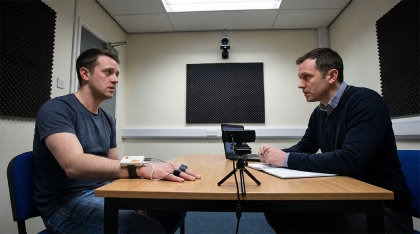
The traditional polygraph is widely criticized for relying on a single physiological channel and its vulnerability to countermeasures (National Research Council, 2003). A multimodal approach, as enabled by iMotions, offers a more robust alternative. Research has shown that deception produces concurrent signatures across multiple channels, such as elevated skin conductance, increased heart rate, subtle facial muscle changes, and conflict-related EEG patterns (Rosenfeld, 2020; Sen et al., 2025; Vrij et al., 2017). No single channel is definitive, but convergence across modalities strengthens inferential confidence (Meijer et al., 2016).
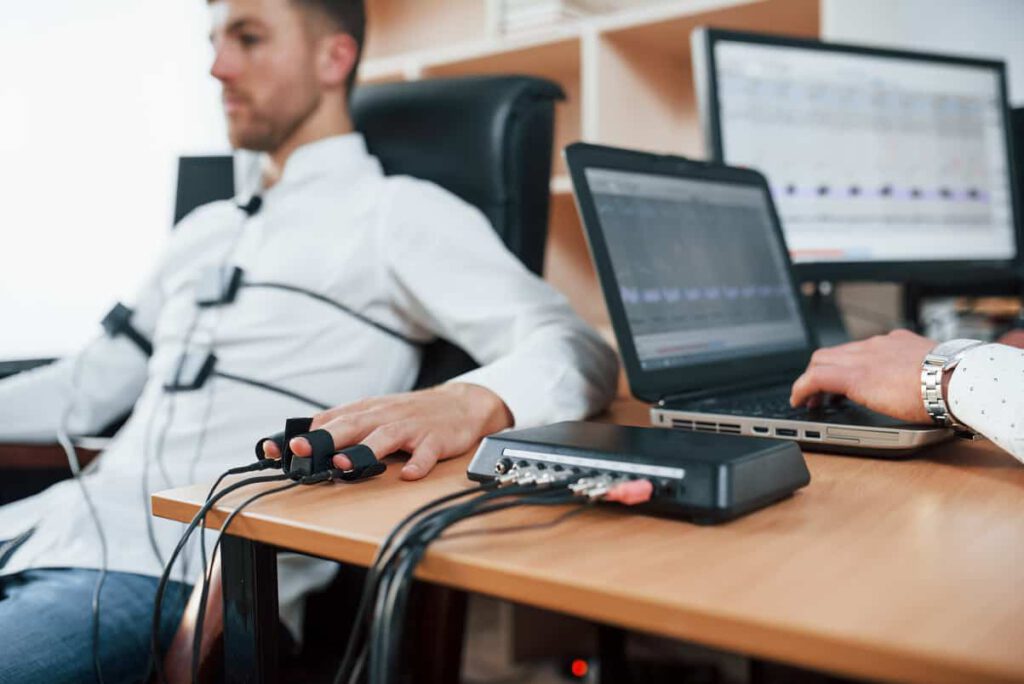
Multimodal deception research remains primarily in the scientific domain rather than courtroom admissibility, but these methods are increasingly informing investigative interview protocols and the scientific grounding of credibility assessment (Granhag et al., 2015).
Eyewitness Memory and Testimony Research
Eyewitness testimony is both powerful and notoriously unreliable. Human memory is reconstructive, susceptible to suggestion, and degraded by stress (Laney & Loftus, 2024; Loftus & Palmer, 1974). Eye tracking studies have documented the weapon focus effect, where a witness’s attention is captured by a visible weapon at the expense of encoding the perpetrator’s face (Fawcett et al., 2013; Loftus et al., 1987; Steblay, 1992). iMotions allows researchers to replicate and quantify this effect under controlled conditions, generating evidence that can inform judicial guidance on eyewitness reliability and support better lineup and interview procedures (Biggs et al., 2023; National Research Council, 2014).
Victim and Trauma Response Research
Trauma profoundly alters memory encoding, behavioral response, and the coherence of testimony (van der Kolk & Fisler, 1995; Schwabe et al., 2023). Biometric research can help investigators and prosecutors understand why a victim’s account may appear fragmented or inconsistent (Bedard-Gilligan & Zoellner, 2012). Research on tonic immobility, a freeze response during sexual assault, illustrates this well: physiological measurement can provide empirical grounding for expert testimony about trauma responses, countering assumptions that a calm or delayed reaction signals fabrication (Bovin et al., 2008; Möller et al., 2017; Rubin & Bell, 2023).
Offender Profiling and Risk Assessment
Attentional and physiological responses to specific stimulus categories can supplement clinical interview data in forensic psychiatric evaluations. Psychopathy, for instance, is associated with reduced skin conductance responses to threat and atypical fear processing (Birbaumer et al., 2005; Blair, 2005; Lykken, 1957). Research using iMotions has deepened understanding of these neurophysiological profiles, informing risk assessment instruments used in parole decisions and treatment planning (Patrick, 2018; Veit et al., 2013).
Crime Scene Simulation and Investigator Training
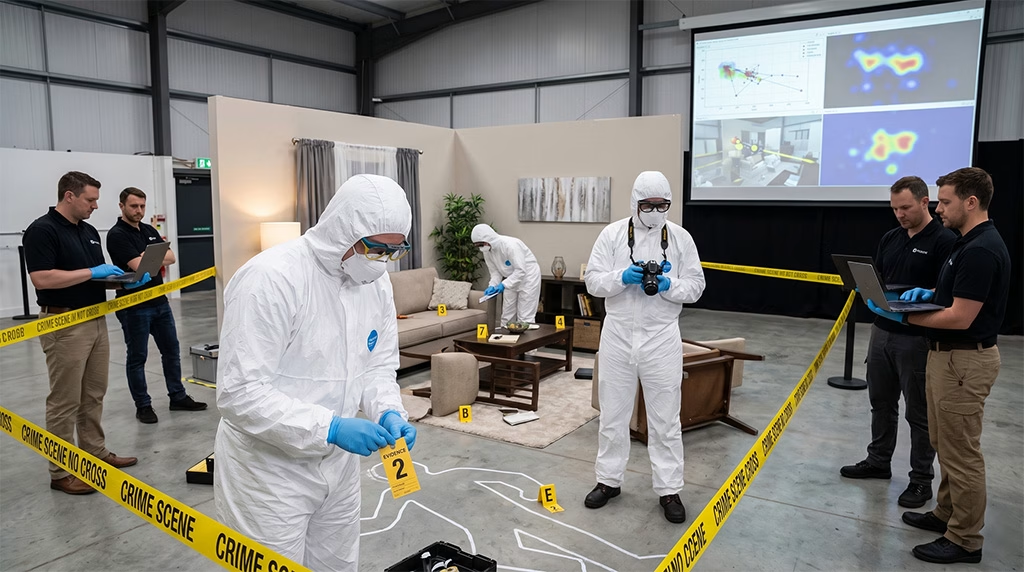
Eye tracking and physiological monitoring during simulated crime scene investigations allow trainers to objectively assess where investigators direct attention, what they overlook, and how stress affects decision-making (Tung et al., 2025). Virtual reality environments, increasingly integrated with iMotions, enable repeatable, ecologically valid simulations, revealing attentional blind spots and cognitive biases that experienced supervisors might otherwise miss (Reichherzer et al., 2021; van Gelder et al., 2014).
Challenges, Limitations, and Ethical Considerations
Several significant challenges attend the forensic application of behavioral biometrics. Ecological validity remains a central concern: measurements obtained in controlled environments do not always translate cleanly to real-world contexts such as interrogations or courtrooms, and participants who know they are being observed may alter their responses (National Research Council, 2003).
At the same time, interpretation is not a matter of applying a single, ready-made metric. Physiological signals must be understood in combination, and in relation to the specific context in which they are recorded. Individual variation is substantial, baselines shift with genetics, health, medication, and personality, meaning that reliable inference depends on identifying which configurations of measures hold under which conditions, rather than assuming universal applicability (Burgoon, 2018; Meijer et al., 2016).
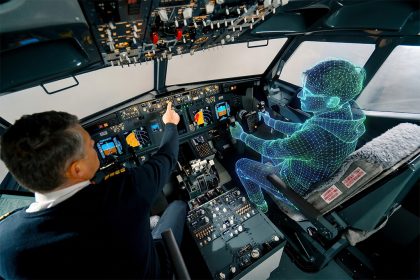
Some emerging approaches extend beyond traditional biosignals, incorporating additional data streams such as pressure sensors embedded in seating to capture subtle behavioral shifts. While not universally integrated across platforms, these developments reflect a broader trend in the field toward richer, context-aware measurement.
The history of the polygraph serves as a cautionary precedent. A method grounded in real physiological principles was operationalized beyond its evidential limits, at times contributing to wrongful conclusions (National Research Council, 2003). The lesson is clear: multimodal biometric approaches must be validated rigorously, applied transparently, and interpreted with restraint, particularly in high-stakes forensic settings.
Privacy considerations are equally critical. Biometric data is among the most sensitive forms of personal information, and its use in forensic contexts requires strict legal governance, robust consent procedures, and comprehensive data security to prevent misuse or overreach (Mordini & Tzovaras, 2012; Smith & Miller, 2022; UK Home Office Biometrics and Forensics Ethics Group, 2024).
Looking Ahead: The Future of Behavioral Forensics
Advances in machine learning, wearable sensors, and virtual reality are rapidly expanding what behavioral measurement can achieve (Sen et al., 2025; Tung et al., 2025). These developments, integrated with platforms like iMotions Lab, promise richer, faster, and more ecologically valid assessments that are applicable as a complement to, rather than a replacement for, traditional forensic evidence. For this potential to be realized responsibly, the forensic and legal communities must fund robust validation research, establish admissibility standards, and build behavioral science literacy among legal professionals.
Conclusion
Human behavior research, powered by multimodal platforms like iMotions, represents one of the most promising frontiers in forensic science. By enabling precise, objective measurement of physiological and behavioral responses, these tools deepen our understanding of deception, memory, trauma, and cognitive bias in ways directly relevant to criminal investigation and legal proceedings.
The challenge ahead is not entirely technological; it is equally conceptual and institutional. The forensic community must embrace behavioral science with rigor and ethical seriousness, deploying these tools where they genuinely serve justice while resisting the temptation to overreach. Used wisely, they have the potential to make the justice system more accurate, more humane, and more just.
References
Bedard-Gilligan, M., & Zoellner, L. A. (2012). Dissociation and memory fragmentation in posttraumatic stress disorder: An evaluation of the dissociative encoding hypothesis. Memory, 20(3), 277–299. https://doi.org/10.1080/09658211.2012.655747
Biggs, A. T., Brennan, A. A., Lin, E., Pickel, K. L., & Sneyd, A. (2023). Revisiting the role of attention in the “weapon focus effect”: Do weapons draw gaze away from the perpetrator under naturalistic viewing conditions? Attention, Perception, & Psychophysics, 85, 1868–1887. https://doi.org/10.3758/s13414-023-02681-w
Birbaumer, N., Veit, R., Lotze, M., Erb, M., Hermann, C., Grodd, W., & Flor, H. (2005). Deficient fear conditioning in psychopathy: A functional magnetic resonance imaging study. Archives of General Psychiatry, 62(7), 799–805. https://doi.org/10.1001/archpsyc.62.7.799
Blair, R. J. R. (2005). Applying a cognitive neuroscience perspective to the disorder of psychopathy. Development and Psychopathology, 17(3), 865–891. https://doi.org/10.1017/S0954579405050418
Bovin, M. J., Jager-Hyman, S., Gold, S. D., Marx, B. P., & Sloan, D. M. (2008). Tonic immobility mediates the influence of peritraumatic fear and perceived inescapability on posttraumatic stress symptoms among sexual assault survivors. Journal of Traumatic Stress, 21(4), 402–409. https://doi.org/10.1002/jts.20354
Burgoon, J. K. (2018). Microexpressions are not the best way to catch a liar. Frontiers in Psychology, 9, 1672. https://doi.org/10.3389/fpsyg.2018.01672
Ekman, P., & Friesen, W. V. (1969). Nonverbal leakage and clues to deception. Psychiatry, 32(1), 88–106. https://doi.org/10.1080/00332747.1969.11023575
Ekman, P., & Friesen, W. V. (1978). Facial action coding system: A technique for the measurement of facial movement. Consulting Psychologists Press.
Fawcett, J. M., Russell, E. J., Peace, K. A., & Christie, J. (2013). Of guns and geese: A meta-analytic review of the “weapon focus” literature. Psychology, Crime & Law, 19(1), 35–66. https://doi.org/10.1080/1068316X.2011.599325
Granhag, P. A., Vrij, A., & Verschuere, B. (Eds.). (2015). Detecting deception: Current challenges and cognitive approaches. Wiley-Blackwell.
Laney, C., & Loftus, E. F. (2024). Eyewitness testimony and memory biases. In R. Biswas-Diener & E. Diener (Eds.), Noba textbook series: Psychology. DEF Publishers. https://nobaproject.com/modules/eyewitness-testimony-and-memory-biases
Loftus, E. F., Loftus, G. R., & Messo, J. (1987). Some facts about “weapon focus.” Law and Human Behavior, 11(1), 55–62. https://doi.org/10.1007/BF01044839
Loftus, E. F., & Palmer, J. C. (1974). Reconstruction of automobile destruction: An example of the interaction between language and memory. Journal of Verbal Learning and Verbal Behavior, 13(5), 585–589. https://doi.org/10.1016/S0022-5371(74)80011-3
Lykken, D. T. (1957). A study of anxiety in the sociopathic personality. Journal of Abnormal and Social Psychology, 55(1), 6–10. https://doi.org/10.1037/h0047232
Matsumoto, D., & Hwang, H. C. (2018). Microexpressions differentiate truths from lies about future malicious intent. Frontiers in Psychology, 9, 2545. https://doi.org/10.3389/fpsyg.2018.02545
Meijer, E. H., Verschuere, B., Gamer, M., Merckelbach, H., & Ben-Shakhar, G. (2016). Deception detection with behavioral, autonomic, and neural measures: Conceptual and methodological considerations that warrant modesty. Psychophysiology, 53(5), 593–604. https://doi.org/10.1111/psyp.12609
Möller, A., Söndergaard, H. P., & Helström, L. (2017). Tonic immobility during sexual assault—A common reaction predicting post-traumatic stress disorder and severe depression. Acta Obstetricia et Gynecologica Scandinavica, 96(8), 932–938. https://doi.org/10.1111/aogs.13174
Mordini, E., & Tzovaras, D. (Eds.). (2012). Second generation biometrics: The ethical, legal and social context. Springer. https://doi.org/10.1007/978-94-007-3892-8
National Research Council. (2003). The polygraph and lie detection. The National Academies Press. https://doi.org/10.17226/10420
National Research Council. (2014). Identifying the culprit: Assessing eyewitness identification. The National Academies Press. https://doi.org/10.17226/18891
Patrick, C. J. (Ed.). (2018). Handbook of psychopathy (2nd ed.). Guilford Press.
Reichherzer, C., Cunningham, A., Coleman, C., Cao, R., McManus, K., Sheppard, D., Kohler, M., Billinghurst, M., & Thomas, B. H. (2021). Bringing the jury to the scene of the crime: Memory and decision-making in a simulated crime scene. In Proceedings of the 2021 CHI Conference on Human Factors in Computing Systems (Article 709, pp. 1–12). Association for Computing Machinery. https://doi.org/10.1145/3411764.3445464
Rosenfeld, J. P. (2020). P300 in detecting concealed information and deception: A review. Psychophysiology, 57(7), e13362. https://doi.org/10.1111/psyp.13362
Rubin, D. C., & Bell, C. F. (2023). Tonic immobility (freezing) during sexual and physical assaults produces stronger memory effects than other characteristics of the assaults. Memory, 31(5), 678–688. https://doi.org/10.1080/09658211.2023.2188642
Schwabe, L., Hermans, E. J., Joëls, M., & Roozendaal, B. (2023). Mechanisms of memory under stress. Neuron, 110(9), 1450–1467. https://doi.org/10.1016/j.neuron.2022.02.020
Sen, T., Ali, M. R., Hoque, M. E., Epstein, R., & Kautz, H. (2025). Multimodal machine learning for deception detection using behavioral and physiological data. Scientific Reports, 15, Article 92399. https://doi.org/10.1038/s41598-025-92399-6
Smith, M., & Miller, S. (2022). The ethical application of biometric facial recognition technology. AI & Society, 37(1), 167–175. https://doi.org/10.1007/s00146-021-01199-9
Steblay, N. M. (1992). A meta-analytic review of the weapon focus effect. Law and Human Behavior, 16(4), 413–424. https://doi.org/10.1007/BF02352267
Tung, P.-Y., Cheng, B.-J., Liu, T.-J., & Wang, J.-C. (2025). Analyzing visual attention in virtual crime scene investigations using eye-tracking and VR: Insights for cognitive modeling. Electronics, 14(16), 3265. https://doi.org/10.3390/electronics14163265
UK Home Office Biometrics and Forensics Ethics Group. (2024). Biometrics and Forensics Ethics Group principles. GOV.UK. https://www.gov.uk/government/publications/ethical-principles-biometrics-and-forensics-ethics-group
van der Kolk, B. A., & Fisler, R. (1995). Dissociation and the fragmentary nature of traumatic memories: Overview and exploratory study. Journal of Traumatic Stress, 8(4), 505–525. https://doi.org/10.1002/jts.2490080402
van Gelder, J.-L., Otte, M., & Luciano, E. C. (2014). Using virtual reality in criminological research. Crime Science, 3, 10. https://doi.org/10.1186/s40163-014-0010-5
Veit, R., Konicar, L., Klinzing, J. G., Barth, B., Yilmaz, Ö., & Birbaumer, N. (2013). Deficient fear conditioning in psychopathy as a function of interpersonal and affective disturbances. Frontiers in Human Neuroscience, 7, 706. https://doi.org/10.3389/fnhum.2013.00706
Vrij, A. (2008). Detecting lies and deceit: Pitfalls and opportunities (2nd ed.). Wiley.
Vrij, A., Fisher, R. P., & Blank, H. (2017). A cognitive approach to lie detection: A meta-analysis. Legal and Criminological Psychology, 22(1), 1–21. https://doi.org/10.1111/lcrp.12088