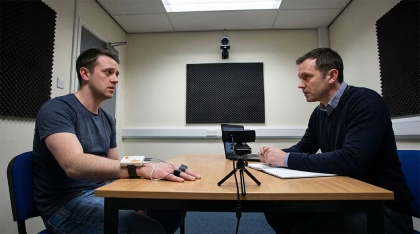

Affectiva’s Emotion SDK is now available on Android, enabling real-time facial expression analysis directly on mobile devices. The new edge-based AI architecture delivers faster performance, offline functionality, stronger privacy protection, and lower cloud costs for emotion-aware apps across healthcare, automotive, gaming, research, retail, and interactive media experiences.

Table of Contents
One of the biggest constraints on expression recognition AI has never really been the models themselves, it has been the limitations on the deployment of them.
In recent years, running behavioral intelligence in real time for mobile applications typically meant relying on cloud infrastructure, which entails capturing video locally, transmitting it to remote servers, processing it there, and then returning the results back to the application.
But much of that overhead is eliminated with the re-introduction of edge computing on Android.
We are excited to announce that The Affectiva Emotion SDK has officially been ported to Android, marking a major milestone in the evolution of our core expression recognition AI technology.
With existing support already available for Windows and Ubuntu, this latest release dramatically expands where and how developers can deploy Affectiva’s advanced facial expression and emotion tracking capabilities. More importantly, it brings the full power of the SDK directly onto mobile devices, enabling entirely local, on-device processing for Android smartphones, tablets, embedded systems and other devices.
This launch extends our entire existing suite of globally successful expression detection capabilities to the world’s most widely used mobile operating system. Developers can now integrate Affectiva’s technology into Android-based applications while benefiting from real-time performance, enhanced privacy, and significantly reduced infrastructure requirements.
Bringing Expression Recognition AI to the Edge
The Android port represents a major step toward edge-based expression recognition AI.
While Affectiva’s SDK has always been available to run personal laptops, mobile devices were limited to leaning on cloud infrastructure with heavy optimization to deliver the same experience. Now video frames are processed directly on the Android device in real time, without requiring raw images or recordings to be uploaded to external servers.
For developers building privacy-sensitive applications, this changes the deployment equation entirely.
In industries where compliance, latency, and reliability matter, local processing is rapidly becoming a requirement rather than a preference. By moving emotion analysis directly onto the device, developers gain greater control over both performance and data handling, while users benefit from faster, more responsive experiences.
Privacy-First by Design
One of the most significant advantages of on-device processing is privacy.
Because the SDK performs facial analysis locally, raw camera feeds and image data never need to leave the device. This “privacy-by-design” architecture helps organizations navigate increasingly strict data protection frameworks such as GDPR and CCPA, while also supporting deployments in highly sensitive environments.
For healthcare applications, automotive systems, wellness platforms, and enterprise solutions, minimizing cloud dependency can dramatically simplify both compliance and user trust.
This also creates new opportunities for opt-in consumer experiences. Users are often far more comfortable interacting with emotion-aware systems when they know their video data is not being transmitted or stored remotely.
Real-Time Performance Without the Cloud
Running locally on Android devices also eliminates the latency associated with server-based processing.
Without the need to send video streams to the cloud and wait for responses, the SDK can deliver truly real-time expression tracking directly on-device. This enables responsive applications where milliseconds matter, including interactive gaming, adaptive media experiences, in-cabin monitoring systems, and live feedback environments.
Developers can now build Android applications that respond instantly to user expressions, without relying on continuous connectivity or expensive backend infrastructure.
The result is a more fluid and scalable architecture for emotion-aware applications.

Offline Expression Recognition AI
The Android SDK also functions without an active internet connection.
Applications built with the SDK can continue operating in airplane mode, remote environments, or locations with unreliable cellular service. This opens deployment possibilities for field research, travel environments, embedded systems, automotive applications, and edge devices where persistent cloud access cannot be guaranteed.
Offline capability is particularly important for mobile and embedded deployments, where reliability and consistency are essential.
Lower Infrastructure Costs at Scale
Cloud-based video processing can become prohibitively expensive at scale.
By shifting computation onto the user’s Android device, developers can dramatically reduce server-side processing costs while still delivering advanced facial expression analysis. This allows organizations to scale emotion-aware applications to significantly larger audiences without incurring exponential cloud infrastructure expenses.
For companies deploying across millions of devices, edge processing offers a far more sustainable path to large-scale deployment.
Expanding the Reach of Emotion-Aware Applications
Android powers billions of devices globally, spanning smartphones, tablets, immersive systems, kiosks, smart displays, and vehicle infotainment platforms through Android Automotive.
By bringing the Affectiva Emotion SDK to Android, developers can now integrate advanced expression analysis into a much broader ecosystem of products and experiences.
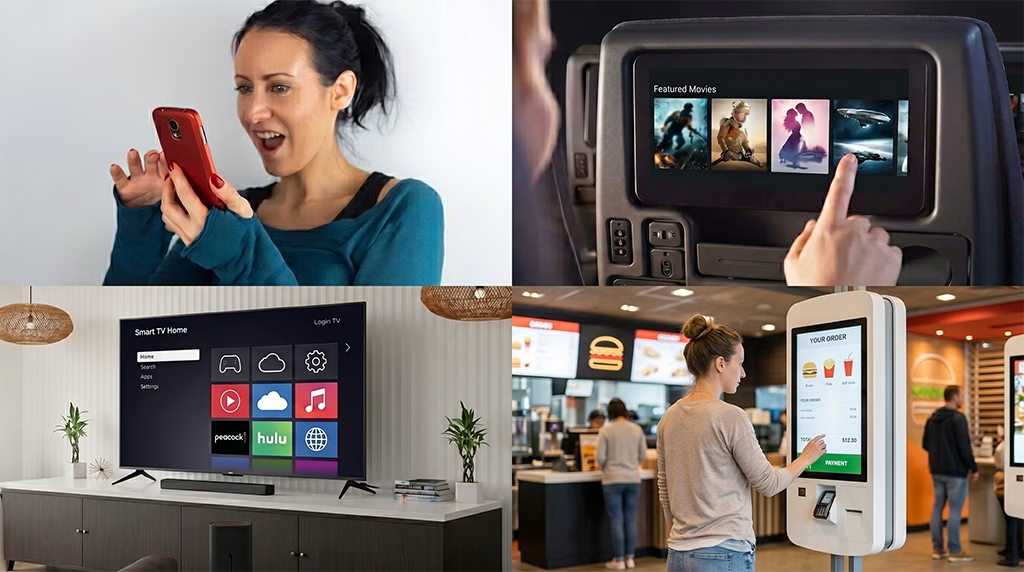
Potential applications include:
- In-cabin automotive infotainment systems requiring low-latency local processing for personalized media experiences, adaptive interfaces, and real-time occupant interaction.
- Mobile gaming experiences that adapt dynamically to player reactions to enhance difficulty or narrative pacing.
- Wellness and mindfulness apps that track non-verbal responses in real time to provide biofeedback and personalized coaching.
- Telehealth and healthcare applications where privacy is critical, enabling secure patient monitoring and diagnostic support.
- Mobile market research studies conducted directly on participant devices to capture authentic consumer sentiment in natural environments.
- Immersive media and in-flight entertainment experiences driven by real-time emotional feedback and audience engagement.
- Self-service and retail interaction monitoring to optimize the customer journey at order kiosks and transaction points.
- Real-time sentiment tracking for digital signage and public interfaces to measure the effectiveness of outdoor advertising and interactive displays.
- Smart home and appliance interactions that adjust UI/UX based on the user’s immediate emotional state.
Because the SDK supports local inference directly on the device, these applications can now operate with lower latency, stronger privacy protections, and far greater deployment flexibility.
A New Chapter for Mobile Expression Recognition AI
The Android release is more than a platform expansion. It represents a broader shift toward scalable, privacy-conscious, edge-based expression recognition AI.
As developers increasingly move intelligence onto local devices, the ability to run advanced facial expression analysis directly on Android opens the door to a new generation of real-time, emotion-aware applications.
With support for Windows, Ubuntu, and now Android, the Affectiva Emotion SDK continues to expand the environments where expression recognition AI can be deployed, integrated, and scaled.

Affectiva Facial Coding SDK
Real-Time Emotion Sensing In Digital Experiences and Applications