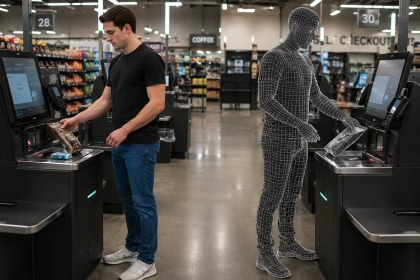

Online survey fraud is evolving rapidly with AI bots, fake respondents, and repeat takers. Discover the latest fraud detection strategies and how biometric verification can improve data integrity.
Table of Contents
Online data collection has become the default for human behavior research. It is convenient, fast, affordable, and it can reach people who would never walk into a lab. But the same openness that makes online studies powerful also makes them vulnerable. When a survey link escapes into the untamed wilds of the internet and a cash incentive is attached to it, you are most likely no longer studying only the population you intended to study. You may be studying professional survey takers, duplicate accounts, automated bots, and, increasingly, large language models pretending to be people.
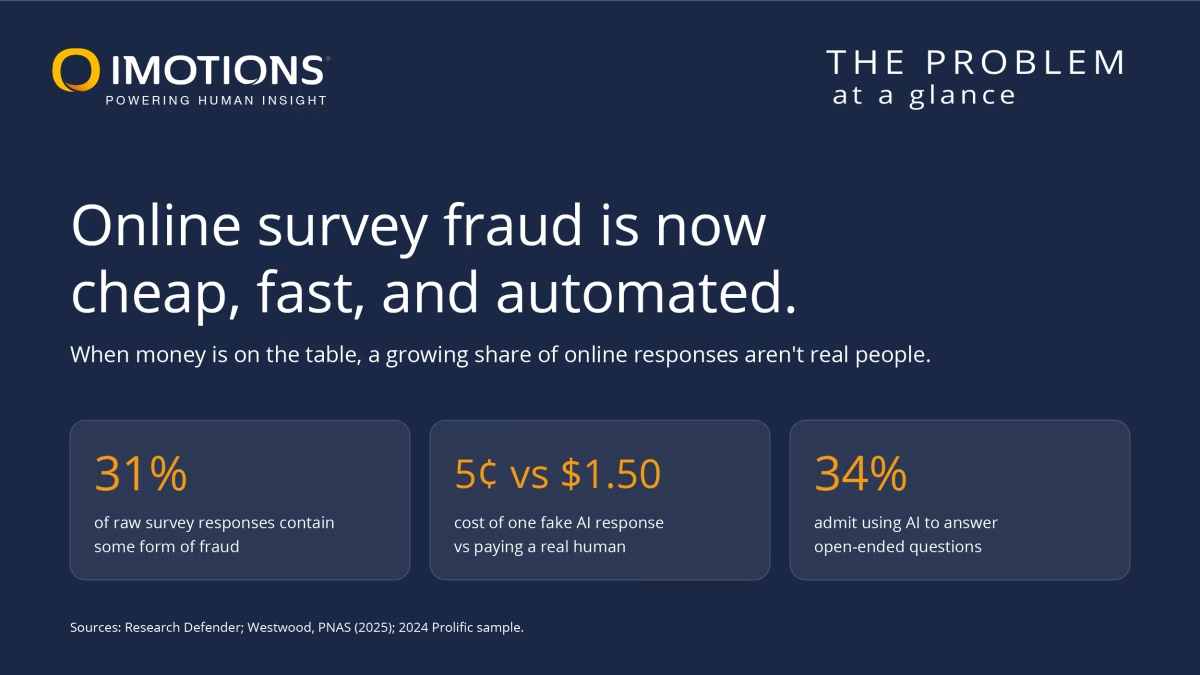
This is not a fringe concern, and it is one of the central threats to the validity of online research. The data-quality firm Research Defender has estimated that roughly 31% of raw survey responses contain some form of fraud, even well before anyone accounts for AI.
For researchers, marketers, and anyone making decisions on the back of consumer or health data, the question is no longer whether deceitful responses will appear when money is on the table, but how to find and remove them before they corrupt the data, and the subsequent conclusions.
Why incentivized online surveys attract bad actors
The mechanics of fraud are painfully simple. Many online panels and community recruitment methods rely on what is sometimes referred to as river sampling, which essentially means open enrollment with low barriers to entry. Anyone with the link can participate, and the compensation (a $20 gift card, a few dollars per completion) is precisely the motivation a fraudulent respondent needs.
A revealing case comes from researchers at the University of South Florida, who set out to study the effect of anti-tobacco public service announcements but stumbled onto a methodological problem instead. Their community recruitment link, attached to a $20 gift-card incentive, leaked well beyond its intended audience and circulated “in the wild,” where bad actors picked it up to claim the reward.
Some might say that more data is always desirable when trying to get an overview of a research question. However, the contrast with their vetted commercial panel was stark. In the leaked community sample, 58% of responses were classified as deceitful and only 42% as valid, whereas the vetted panel produced about 87% valid responses. It is important to note that the lesson is not that community recruitment is not worth the time or that panels are flawless, as vetted panels carry their own risk of disengaged, habitual survey takers, but that incentives plus open access reliably invite manipulation.
There are three overlapping threats to watch for:
- Ineligible humans who misrepresent themselves (age, location, health status, behavior) to qualify for the incentive.
- Careless or disinterested humans who rush, straight-line, or multitask their way through without genuine engagement.
- Automated and semi-automated agents, which can comprise everything from crude scripts to sophisticated AI, that complete studies at scale, at speed, with no human behind them.
It is that third category that has changed most dramatically, and most dangerously.
The escalation that broke the old defenses: AI-generated respondents
Up until very recently, fraudulent responses were a labor-intensive, low-margin business. After all, someone would have to sit and actually do them to cash out as it were. The rise of LLMs and agentic automation has changed that landscape significantly. A 2024 study of a Prolific sample found that 34.3% of respondents reported using AI to help answer open-ended questions, and those are just the participants willing to admit to it.
The more serious development lies with the aforementioned fully autonomous AI agents. In late 2025, Dartmouth researcher Sean Westwood published work in PNAS demonstrating an AI agent that could pass as a human survey participant while evading every detection method currently in use. In this case the incentive to deploy a tool like that is obvious, because the cost asymmetry is brutal. A human respondent typically earns around $1.50 per survey, while the AI could generate a polished, demographically tailored response for roughly five cents.
Westwood’s analysis suggested that, across several major pre-election national polls in 2024, as few as 10 to 52 fake responses could have been enough to flip the predicted outcome. When the models were asked outright whether they were human or machine, they reliably chose the human answer.
Researchers studying this phenomenon sometimes refer to it as “LLM Pollution”. They distinguish between partial mediation (a real participant using AI to polish wording or “translate” an answer to fit the scope of the study question) and full delegation (an agent completing the entire study unsupervised at scale and at speed). Both undermine the foundational assumption of human-subject research, which is that a coherent response came from a human mind that is eligible to answer a given research question. One lab reported observing apparent LLM-mediated content in up to 45% of submissions.
The uncomfortable takeaway is that the old safeguards such as attention checks, simple bot filters, “are you human?” questions, and reCAPTCHA scoring, were designed for less capable adversaries. They can still catch the crude bots, but they no longer reliably catch the smart ones. A defense built entirely around analyzing what a respondent types is now fighting a system specifically good at producing human-sounding text, which is echoing the “bringing a knife to a gunfight” analogy.
The case for putting a camera on the survey
So, how can researchers go about trying to minimize fraudulent survey submissions? One answer is to integrate surveys into online biometric research studies. If the core weakness of text-based fraud detection is that AI is good at text, then the most direct response is to require something AI and duplicate accounts are not good at faking, such as a live, attentive human face, captured through the webcam for the duration of the study and analyzed for expressions and attention as a valid part of the study.
It is not a perfect, foolproof solution, no single method likely is. But it is a somewhat safe one, and it neutralizes the two forms of fraud that are hardest to stop by other means.
It defeats automated AI agents at scale
An LLM agent can generate a flawless open-ended answer, fill in demographics, and even mimic plausible response timing. What it cannot do is sit in front of a camera and present a continuous, consistent, genuinely attentive human face across an entire session on demand.
The moment a study requires live facial data, and live attention metrics, the economics that make AI fraud attractive collapse almost completely. The whole appeal of an automated agent is that it completes studies at scale and speed for pennies. By requiring a real face, which means there has to be a real person physically present for each completion, forcefully re-implements the bottleneck that scaled, automated fraud is designed to avoid.
The University of South Florida case shows the detection working in practice. By recording participants through their webcams and running facial expression analysis and attention metrics, the team classified respondents as valid, disinterested, or deceitful based on signals that are difficult to fake in real time. A respondent who smirked at the camera turned out to be associated with cheating roughly 85% of the time. Bad actors who tried to evade the camera — replacing their face with a photo, switching off the lights produced exactly the kind of missing or corrupted signal that flags a response for immediate exclusion. A bot has no face to show, and an evasive human gives themselves away by trying to hide.
It catches the repeat taker
The second hard-to-solve fraud is the individual who takes the same study several times to collect the incentive again and again. Email addresses can be spun up endlessly, IP addresses can easily be masked with a VPN, and device fingerprints can be reset. But if every session captures the participant’s face, the same person showing up under three different identities can be matched and removed, simply because their face features in each attempt. Facial data turns “one person, many accounts” from a near-invisible problem into a detectable one, in a way that metadata checks alone cannot reliably manage.
Why “somewhat” safe, and not airtight
Honesty matters here, because overclaiming is its own kind of risk. A camera-backed study is far harder to defraud at scale, but it is not immune:
Partial LLM mediation still exists. A real human can sit in front of the camera while quietly pasting AI-written text into the open-ended boxes. The face defeats the bot but it does not defeat a human using AI as a crutch by itself, which also means that content review of open-ended answers still matters a lot.
Behavioral signals alone are not a panacea. A 2026 PNAS commentary, pointedly titled “Will online behavioral research follow the fate of online survey research?”, found AI-consistent patterns even in reaction-time data – a domain long assumed to be protected by human perceptual-motor limits. The reassuring flip side is that this is precisely why the live-face requirement matters. Faking millisecond timing is easy for an advanced AI agent, but presenting a real, continuous human face is the genuinely hard part for most automated systems.
Quality, selection, and privacy tradeoffs are real. Webcam methods depend on the participant’s hardware, lighting, and positioning, which raises exclusion rates, and you only capture people willing to enable a camera. Researchers at UC Riverside, studying a stigmatized population, found that stronger verification protects data quality but can deter exactly the vulnerable, hard-to-reach participants you want. Which is a tension worth designing around rather than ignoring.
So the right framing is not “a camera solves fraud.” It is that adding live facial and attention data removes the cheapest, most scalable forms of fraud, automated AI agents and repeat takers, and makes the rest more detectable. That is a meaningful raising of the floor so to speak.
Solving respondent fraud with iMotions Online
The challenge of respondent fraud becomes far more manageable when survey tools and biometric integration exist within the same platform. That is exactly what iMotions Online is designed to do. As a browser-based research platform, it combines a full-featured survey builder with webcam eye tracking and facial expression analysis, transforming what would traditionally be separate survey and biometric workflows into a single, integrated study.
In practice, participants simply open a study link in a web browser using a standard laptop or desktop computer equipped with a webcam and internet connection. As they interact with the presented stimuli, iMotions Online measures visual attention through WebET 3.0 webcam eye tracking and captures facial expressions using Affectiva AFFDEX, the same facial-coding technology used in academic and commercial research worldwide. Only after this biometric component has been completed does the participant proceed to the survey portion of the study. The result is that every survey response is accompanied by evidence that a real person was present, looking at the stimulus, and actively participating in the study.
This directly addresses the two most common forms of respondent fraud. Before the first survey question is answered, participants must complete a brief eye-tracking calibration procedure by following points on the screen with their gaze. Automated agents have no eyes to track and therefore cannot pass this step. Similarly, facial expression analysis requires a real face to be present throughout the session. While no system can completely eliminate repeat participation, researchers can easily identify suspicious cases when the same individual appears multiple times under different identities. The survey is no longer just a simple text box that an LLM can complete for a few cents, it becomes a session that requires the presence and attention of a real human participant.
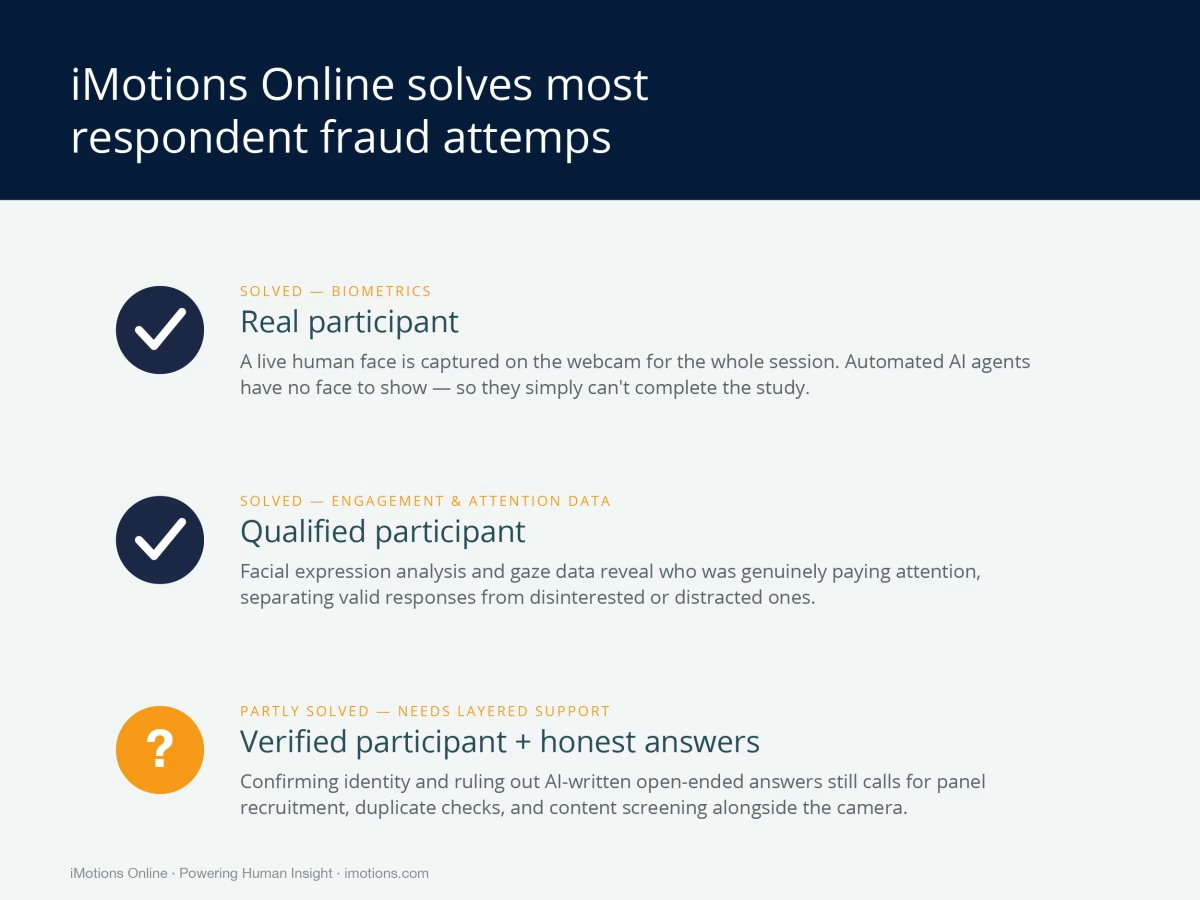
A few capabilities matter specifically for data integrity:
- Surveys and biometrics in one study. The built-in survey tool, with conditional logic and branching, runs inside the same session as eye tracking and facial expression analysis, so attention and engagement data line up with every answer and no third-party survey integration is needed.
- Built-in panel integrations. iMotions Online connects to established panel providers such as Prolific, Qualtrics, CINT, Forsta, Amazon MTurk, and Sona Systems, so vetted recruitment and biometric verification reinforce each other rather than being an either/or choice.
- Engagement and attention metrics. AFFDEX surfaces valence and engagement and detects core emotions, while gaze and attention reveal whether a participant was actually focused. This is the basis for separating valid, disinterested, and deceitful responses.
- GDPR compliant by design. Data is anonymized and stored in secure EU cloud infrastructure with per-project access control, which matters when verification and participant privacy have to coexist.
- A human review backstop. Because every session stores the participant’s face alongside their answers, the researchers reviewing the data become a final line of defence. A reviewer can literally see who took part, so a repeat taker who reappears under a different identity tends to be recognised on sight, even if they slipped past every automated check.
For scientific and commercial studies that need more, the Remote Data Collection module for iMotions Lab extends the same browser-based collection with screen and audio recording, speech-to-text, voice analysis, and the platform’s full analysis suite.
Defense in layers, with biometrics as the anchor
The consensus across the research literature is that no individual method is fully sufficient; robust studies stack independent checks so a respondent who slips past one is caught by another. A second case study makes the point. Researchers led by UC Riverside, publishing in AIDS and Behavior, ran an online trial whose funnel is instructive: of 9,321 people who completed the screener, 2,637 met eligibility, only 251 survived legitimacy and duplication checks, 158 completed consent, and 115 finished the study. Automated detection caught most problematic entries, but manual review and live verification were necessary to close the gaps — and they concluded that verification should be a core component of study design, budgeted from the start.
A practical, layered toolkit looks like this, with live biometric capture as the anchor that the other layers reinforce:
At recruitment and design
- Favor vetted, ID-checked panels over open links when integrity matters most.
- Build the study as a webcam-based session so facial expression and attention are captured throughout.
- Add attention and instructional-manipulation checks and honeypot questions (invisible to humans, answered by bots).
During collection (metadata and technical signals)
- Enable reCAPTCHA / bot-probability scoring and collect rich metadata.
- Monitor completion times, IP and geolocation, and duplicate-detection signals.
- Use facial matching across sessions to catch repeat takers operating under multiple identities.
After collection (analysis and review)
- Use facial expression and attention data to classify valid, disinterested, and deceitful respondents.
- Apply statistical outlier detection (e.g. Mahalanobis distance, person-total correlation).
- Manually review open-ended answers for the verbose, generic signatures of AI.
Crucially, these methods need to be planned before launch. Teams that try to clean a contaminated dataset after the fact often face the worst outcome of all — being unable to confidently separate real from fake responses, and having to abandon the data entirely, a fate several published teams have reported.
A practical takeaway
If you are running or commissioning online research, treat data integrity as a design decision with a budget, not a post-hoc cleanup task:
- Assume a meaningful fraction of any incentivized online sample is not genuine — and that AI has made the fraud cheaper, faster, and more convincing than the old bot filters were built for.
- Make the study see its participants. Integrating surveys into webcam-based biometric research is one of the few approaches that structurally defeats automated AI agents (they have no face to show) and repeat takers (their face appears in every session).
- Treat it as “somewhat safe,” not foolproof. Pair the camera with content review, metadata checks, and statistical screening so the residual fraud is caught too.
- Balance rigor against access. Over-aggressive verification can drive away the legitimate, hard-to-reach participants you most want, so calibrate to the population and the stakes.
The populations worth studying online are often the ones hardest to reach any other way. Protecting the integrity of that data, through smart design, layered checks, and signals that are genuinely hard to fake, with a live human face chief among them, is what keeps online research worth doing.
References
- iMotions. Weeding Out Deceitful Responses in Online Surveys (University of South Florida case study). https://imotions.com/customer-stories/weeding-out-deceitful-responses-in-online-surveys/
- Hammond, R., Parvanta, C., & Zemen, R. (Underlying USF study, Social Marketing Quarterly.) https://journals.sagepub.com/doi/abs/10.1177/15245004221074403
- Pittalwala, I. Fraud detection critical to online health research, study finds. UC Riverside News, June 11, 2026. https://news.ucr.edu/articles/2026/06/11/fraud-detection-critical-online-health-research-study-finds
- Brown, B., Valente, P. K., O’Connor, G., et al. Procedures to Verify Legitimacy and Uniqueness of Responses in an Online Study with U.S. Young Gay and Bisexual Men Who Use Stimulants. AIDS and Behavior (2026). https://link.springer.com/article/10.1007/s10461-026-05180-9
- Westwood, S. J. The potential existential threat of large language models to online survey research. PNAS 122(47), e2518075122 (2025). https://www.pnas.org/doi/10.1073/pnas.2518075122 (open-access version: https://pmc.ncbi.nlm.nih.gov/articles/PMC12663962/)
- Will online behavioral research follow the fate of online survey research? PNAS 123(8), e2535585123 (2026). https://www.pnas.org/doi/10.1073/pnas.2535585123
- Recognising, Anticipating, and Mitigating LLM Pollution of Online Behavioural Research. arXiv:2508.01390 (2025). https://arxiv.org/abs/2508.01390
- Bonnamy, C., et al. Survey sabotage: Insights into reducing the risk of fraudulent responses in online surveys. Anatomical Sciences Education 18, 767–773 (2025). https://anatomypubs.onlinelibrary.wiley.com/doi/10.1002/ase.70015
- Bots are the new fraud: A post-hoc exploration of statistical methods to identify bot-generated responses in a corrupt data set. Computers in Human Behavior (2023). https://www.sciencedirect.com/science/article/abs/pii/S019188692300212X
- Webcam-based online eye-tracking for behavioral research. Judgment and Decision Making 16(6) (2021). https://www.cambridge.org/core/journals/judgment-and-decision-making/article/webcambased-online-eyetracking-for-behavioral-research/B726E77B68A76577F9BC6BB8F1EBC6E4