

How Consumer Digital Twins Are Reshaping Insights, and Why Biosensor Validation Is Crucial To Their Success
Digital twins of consumers, virtual models that simulate buyer behavior, attention, and emotion, are increasingly transforming marketing research. This article examines the methodology, the validity debate around synthetic respondents, and the role of biosensor platforms like iMotions in grounding consumer twins in real human response.
Table of Contents
The idea of a digital twin reached marketing through a different door than it reached engineering, where the term is perhaps more prevalent. Industrial digital twins began with sensors on physical assets; marketing digital twins began with the recognition that consumers, like turbines and supply chains, could be modeled as systems with measurable inputs and predictable outputs.
Over the past couple of years, the convergence of large language models, behavioral data infrastructure, and consumer neuroscience has accelerated this idea from speculative concept to working methodology – with all the validity questions that rapid adoption produces.
For market research professionals, consumer insights leaders, and academic researchers studying consumer behavior, the consumer digital twin is now a serious methodological option.
This article examines what consumer twins actually are, where they sit in the broader landscape of synthetic respondent methods, what the current research says about their validity, and why biosensor-based validation, the kind enabled by platforms such as iMotions, is becoming critical to the credibility of twin-based insights.
What is a consumer digital twin?
The terminology in this space is unsettled, and clarity matters before going further. The market research industry is converging on three more or less loosely defined categories of synthetic methodology, distinguished primarily by how grounded they are in real-person data.
Pure synthetic respondents are AI-generated personas built from census data, behavioral modeling, and large language model priors. They are not tied to any specific real individual. They are useful for population-level simulations, survey augmentation, and exploratory work where the goal is to approximate aggregate response patterns rather than predict individual behavior.
Synthetic consumers are a specialization of synthetic respondents tuned specifically to market research applications. They are designed to replicate how real buyers think and act when evaluating product concepts, pricing, and messaging, and they are typically deployed for concept testing, message testing, and early-stage exploration.
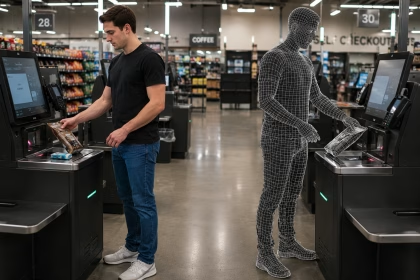
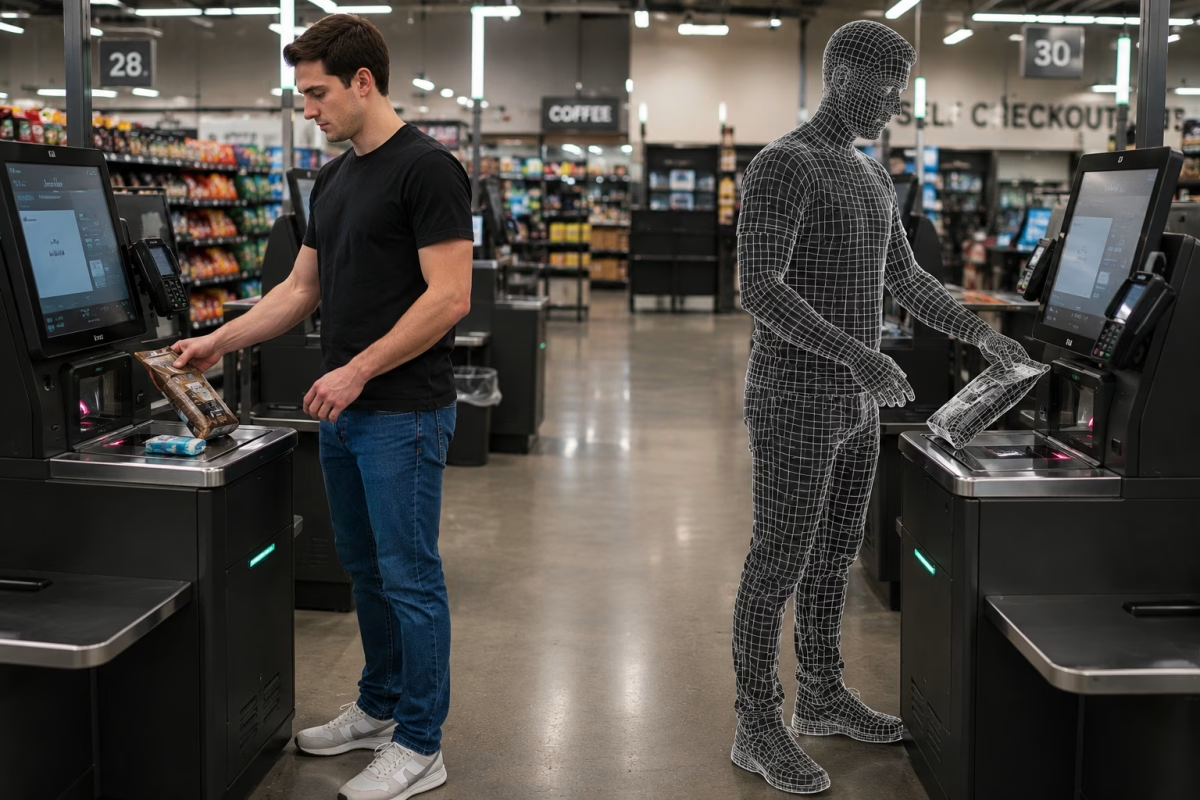
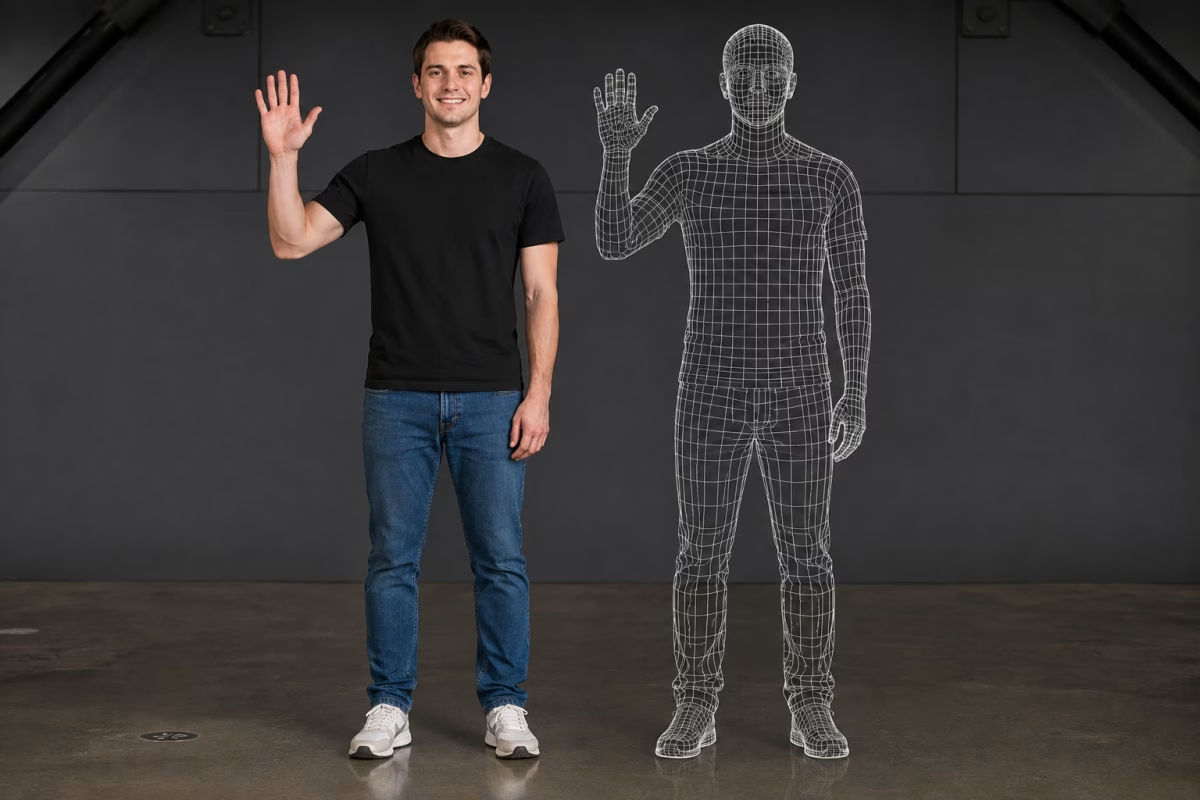
Consumer digital twins sit at the most grounded end of the spectrum. A consumer twin is a virtual representation of a specific person or tightly defined consumer segment, built from real individual-level data from survey responses, behavioral observation, transaction history, interview transcripts, and/or declared preferences, and designed to evolve over time as new data accumulates. Where a synthetic consumer is a generalized persona, a digital twin is a dynamic, calibrated model of a known individual or microsegment.
The distinction matters because the validation strategies, use cases, and risks differ across these categories. A pure synthetic respondent is generally validated against aggregate population statistics. A consumer twin is validated against the actual responses of the real person or segment it represents, which is what allows it to generate predictions specific to that individual or group.
The broader field of synthetic data, of which consumer twins are a specialized application, presents a complex landscape of opportunities and challenges. To understand the wider implications, including the ethical considerations and technical hurdles facing this revolutionary technology, explore our in-depth analysis on Synthetic Data.
How consumer twins are actually built
Most production implementations of consumer twins combine three layers of input.
Behavioral and transactional data forms the empirical backbone. Purchase history, web and app interactions, loyalty program data, media consumption patterns, and CRM records describe what the consumer has actually done. This data has the advantage of being observed rather than self-reported, and it provides the temporal patterns that make a twin dynamic rather than static.
Stated preference and attitudinal data describes what the consumer says about themselves. Survey responses, interview transcripts, focus group output, and panel data fill in the motivations and reasoning that behavioral data alone cannot capture. Retrieval-augmented generation techniques have made it increasingly feasible to ground LLM-based twins in transcripts from real conversations with the represented individuals.
Demographic and contextual data anchors the twin in a defined population — age, income, geography, household composition, life stage. Research has demonstrated that LLM-based synthetic respondents perform substantially better when prompted to consider demographic attributes of the person they are impersonating, with age and income level being particularly important variables for matching real-world response distributions.
The twin itself is typically implemented as an LLM with structured access to this data, augmented with retrieval over the individual’s transcripts and behavioral records, and constrained by prompting or fine-tuning to respond in the manner of the represented person. More sophisticated implementations layer additional behavioral models, purchase intent models, attention models, emotion models, on top of the LLM substrate to produce specific predictions for specific stimuli.
Where consumer twins are being applied
Marketing applications of digital twins are clustered around five overlapping use cases.
Concept and product testing. This is the highest-volume application. A brand evaluates a new product concept, pack design, or formulation by exposing a twin (or a population of twins matched to the target audience) to the stimulus and collecting predicted responses on dimensions such as appeal, uniqueness, purchase intent, and category fit.
Recent research demonstrated that semantic similarity rating methods applied to LLM-based synthetic consumers achieved 90% of human test-retest reliability across 57 personal care product surveys with 9,300 human responses, providing the strongest published evidence to date that synthetic consumers can replicate aggregate human concept evaluation under appropriate methodological conditions.
Advertising and creative testing. Twins can predict which ad variants are likely to perform best on engagement, recall, and persuasion before the brand commits to media spend. The economics are compelling: traditional pre-testing of a single 30-second spot typically requires several hundred respondents and weeks of fieldwork; twin-based pre-testing can run hundreds of variants in hours.
Customer journey simulation and CX optimization. Twins of specific customer segments can be exposed to journey variations — different onboarding flows, retention interventions, service interactions — to identify which paths produce the best outcomes. This shifts journey design from purely historical attribution analysis to forward-looking simulation.
Pricing and assortment research. Conjoint-style willingness-to-pay studies have begun migrating to twin-based methodologies, where the twin evaluates trade-offs across price, feature, and brand combinations at much larger scale than traditional human studies allow.
Personalization and segmentation refinement. At a more analytic level, twins of individual customers (where data permits) can be used to test personalized recommendations, content variants, or offers, helping the personalization engine learn faster than it would from live A/B testing alone.
The validity problem (?)
The methodological energy around consumer twins is matched by a substantial validity literature that is, as of late 2025 and early 2026, decidedly mixed.
The encouraging findings are real. Beyond the personal care product study cited above, peer-reviewed and working-paper research has demonstrated that LLM-based synthetic respondents can reproduce certain aggregate patterns in political opinion, consumer preference, and qualitative response.
Work from the Harvard Business School, MIT Sloan, and several university marketing departments has explored these methods seriously. The International Journal of Research in Marketing, in collaboration with the Marketing Science Institute, has called for submissions to a special issue specifically on generative AI, synthetic data, and synthetic respondents in marketing research, signaling that the academic field considers the topic worth rigorous engagement.
The discouraging findings are equally real. A comprehensive evaluation of nine open and commercial LLMs by Tjuatja and colleagues found that the models generally fail to reflect human-like behavior on item-format response biases that humans reliably exhibit. Bisbee and colleagues, in Political Analysis, documented what they termed “the perils of large language models” as synthetic survey respondents, including substantial sensitivity to prompt wording and demographic prompting strategies. Yu and colleagues, comparing GPT-4 and Llama3 against human responses on standardized empathy questionnaires, found that GPT-4 reproduced the expected factor structure of the questionnaires but not the magnitude of human scores, while Llama3 failed even on factor structure.
Several specific failure modes recur across the literature:
- Sycophancy and positive bias. LLMs trained to be helpful and agreeable often produce unrealistically positive or uncritical feedback when used as synthetic respondents, failing to surface the negative reactions and product flaws that real consumers would identify.
- Insufficient response variance. Synthetic respondents often produce response distributions that are too smooth and too centered, smoothing over the outliers and edge cases that characterize real-world consumer behavior.
- Social desirability bias. Recent research documents that LLMs exhibit human-like social desirability biases in survey responses, which sounds positive until you recognize that this bias is precisely what well-designed market research aims to circumvent.
- Prompt sensitivity. Estimates from synthetic respondents are highly sensitive to prompt wording, persona specification, and option ordering, making it difficult to obtain stable estimates without careful methodological controls.
- Population-level validity but not individual-level validity. Multiple studies have noted that synthetic methods can replicate aggregate response patterns reasonably well while failing to predict the responses of specific individuals — a distinction that matters greatly for personalization applications.
- Hallucination. Generative models occasionally fabricate information that appears plausible but is factually wrong, which can introduce misleading findings if not caught through validation.
The honest summary is that consumer digital twins are useful but not yet trustworthy in isolation. They generate hypotheses well, replicate certain aggregate patterns reliably, and produce qualitative output that is genuinely informative — but their outputs need to be calibrated against real human response before being used to make consequential commercial decisions.
Why biosensor validation matters
This is where the methodological story takes its most interesting turn for marketing researchers. Traditional validation of synthetic respondents has used human survey data as ground truth — comparing the twin’s predicted Likert response to what real humans reported on the same items. This is necessary but insufficient, for a reason that marketers have known for decades: what consumers say about a stimulus and how they actually respond to it are different things.
Consumer neuroscience has documented this gap extensively. The mere act of reflecting on a response can alter the response, and self-report measures are subject to social desirability, recall bias, and post-rationalization. A consumer twin trained to predict what people say will, at best, accurately predict what people say.
It will not necessarily predict pre-conscious attention, emotional valence, cognitive effort, or other dimensions of response that drive actual purchasing behavior — dimensions that the broader consumer neuroscience literature estimates account for the substantial majority of decision-making.
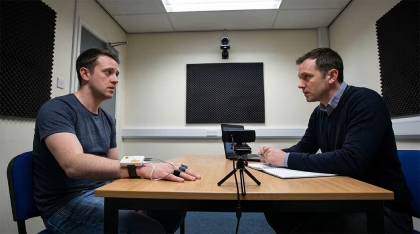
Biosensor-based validation offers a way to bridge this gap. The methodology is straightforward in principle: run the same stimulus that the twin evaluated through a small but representative sample of real respondents instrumented with eye tracking, facial expression analysis, GSR, and where appropriate EEG.
Compare the twin’s predictions on dimensions the biosensors can measure — visual attention patterns, emotional response, arousal, cognitive load — to the actual physiological responses recorded. Use the discrepancies to calibrate the twin and identify where its predictions are reliable versus where they break down.
This calibration-and-validation loop has several attractive properties. Biosensor measures are less subject to the response biases that affect both human surveys and synthetic respondents, providing an independent reference. They generate continuous, time-resolved data rather than single summary scores, which means a single biosensor study can validate twin predictions across many moments within a single stimulus. And the data are generally non-comparable to anything an LLM-based twin can fabricate, which makes them harder to inadvertently leak into the training process.
iMotions gives the ground truth
With iMotions Lab being a multimodal biosensor research platform ideally positioned for consumer neuroscience applications, integrating eye tracking, facial expression analysis, GSR/EDA, EEG, ECG, and voice analysis into a synchronized data collection and analysis environment, consumer twin validation, through several iMotions capabilities are directly relevant.
Multimodal stimulus testing. The iMotions Lab platform supports identical study designs across screen-based studies, VR environments, in-store contexts using eye tracking glasses, and naturalistic settings. For a consumer twin that needs to be validated across digital advertising, packaging, retail environments, and product experiences, this consistency across contexts reduces methodological variance.
Consumer neuroscience methodology coverage. iMotions explicitly supports the core neuromarketing methodologies: visual attention via screen-based eye tracking, emotional response via Affectiva facial expression analysis and voice analysis, physiological engagement via GSR, and neural response via EEG integration. Each of these maps to dimensions of consumer response that a twin would aim to predict.
Survey integration. The platform includes a built-in survey tool that allows researchers to triangulate participants’ stated answers with their non-conscious biosensor responses in the same study. This is particularly useful for twin validation: a research team can collect both the explicit Likert ratings (which the twin was trained to predict) and the implicit biosensor responses (which provide independent validation) in a single integrated dataset.
Scalability across research maturity. iMotions offers configurations ranging from webcam-based remote studies, suitable for larger sample sizes and faster iteration, to advanced multimodal lab setups for high-fidelity validation. For twin-based research programs, this is useful because validation strategies differ at different stages: early-stage methodological work may use lab-grade instrumentation on small samples, while ongoing calibration of a deployed twin may rely on webcam-based remote studies for scale.
Data export and integration. Raw data and derived metrics can be exported in formats compatible with downstream analysis in R, Python, SPSS, and other statistical environments, which allows biosensor outputs to be integrated into the same modeling workflows that train and evaluate the twin itself.
The role iMotions plays in a twin-based research program is not as a replacement for the twin, but as the validation and calibration layer. The twin generates predictions at scale; iMotions provides the ground-truth biosensor data that determines whether those predictions are trustworthy and where they need correction.
This foundational ground truth is indispensable for moving beyond mere predictions to verifiable, impactful understanding in consumer and retail research. To see how these principles translate into actionable insights and significant advancements, delve into the 10 best biosensor studies that are improving consumer and retail insights research today.
A representative validation workflow
A representative methodology for twin-validated consumer research might proceed as follows.
The research team builds or licenses a consumer twin representing the target segment, grounded in available individual-level data — survey responses, interview transcripts, behavioral records, demographic context. Stimulus variants are generated for the research question at hand: ad creative variants, packaging designs, product concepts, journey flows.
The twin evaluates each variant, producing predicted scores on response dimensions of interest (appeal, attention, emotional valence, purchase intent) and qualitative explanations of the ratings. Variants are ranked by predicted performance, and the top candidates plus a small set of contrasting candidates are selected for biosensor validation.
A modest sample of real respondents matched to the target segment is recruited and exposed to the selected stimuli in an iMotions-based study, with eye tracking, facial expression analysis, GSR, and survey responses collected synchronously. The biosensor data are processed into the equivalent response dimensions the twin predicted — attention from gaze patterns, emotional valence from facial expressions, arousal from GSR, explicit ratings from the survey.
The twin’s predictions are compared against the biosensor and survey data. Three outcomes are possible at this point: the twin’s predictions correspond well to the human response (the twin is calibrated for this stimulus type and can be trusted for further variant evaluation), the twin’s predictions are systematically biased in a correctable way (the calibration is adjusted and the workflow continues), or the twin’s predictions fail to correspond to human response (the twin is not appropriate for this stimulus category and traditional methods are required).
The validated twin, with documented calibration, can then be used to evaluate additional variants with greater confidence than an uncalibrated twin would warrant. Periodic re-validation studies ensure that the twin’s predictions continue to track human response as products, markets, and consumer behavior evolve.
Methodological considerations
Several caveats are essential for any team considering twin-based methodologies in consumer research.
Categorial generalization is unproven. Most positive validation results to date have been on relatively constrained product categories — personal care products, consumer packaged goods, advertising in established categories. Performance on complex B2B purchasing decisions, luxury goods, culturally specific products, and genuinely novel categories remains unproven.
Population-level versus individual-level claims. The strongest published evidence supports the use of synthetic methods for aggregate predictions. Claims of individual-level prediction — “this specific customer will respond in this specific way” — are substantially less well-supported and should be treated with caution, particularly for personalization applications where individual accuracy matters.
Data quality of the grounding. A consumer twin is only as good as the individual-level data it is grounded in. Twins built on rich transcripts of conversations with real consumers from the target segment outperform twins built on demographic attributes alone. Investment in the grounding data is generally the highest-leverage methodological decision.
Ethics and privacy. Consumer twins raise distinct ethical questions from operational digital twins. If a twin represents a specific identifiable individual, that individual generally has rights regarding how their data is used and how the twin acts on their behalf. Aggregated segment twins are less ethically fraught but still warrant careful consent and transparency. GDPR, CCPA, and emerging AI-specific regulations are converging on the principle that consumer twins built on personal data require explicit consent and meaningful transparency.
The sycophancy and positivity bias problem is real. Teams using consumer twins for go/no-go decisions on product launches should be particularly cautious about the documented tendency of LLM-based methods to produce overly positive predictions. Biosensor validation is one of the more effective safeguards against this bias because physiological responses are less subject to the same training-induced positivity.
Where the field is heading
Three developments are likely to shape consumer twin methodology over the next several years.
First, the integration of behavioral and biosensor data into twin training is moving beyond validation and toward genuine grounding. Rather than building twins from text and demographics and validating them with biosensors, leading research programs are beginning to incorporate biosensor data directly into the twin’s training, producing twins that predict both stated and non-conscious response dimensions from the outset.
Second, rectification and calibration methods are becoming more sophisticated. Recent academic work has introduced inference-time techniques for adjusting synthetic respondent outputs to better match human response distributions with limited human data — making twin-based research more practical for teams that cannot afford large-scale ongoing human validation.
Third, regulatory and methodological standards are emerging. The market research industry’s professional bodies, academic journals, and major industry buyers are converging on expectations about transparency, validation, and reporting for twin-based research. Studies that report only twin predictions without human validation are increasingly viewed with skepticism, while studies that report both the twin predictions and the biosensor or human validation are treated as legitimate methodological contributions.
Getting started
For research teams considering work in this area, the practical path involves three stages.
First, identify the categories and decisions for which twin-based methods are appropriate — typically high-volume, lower-stakes research questions where speed and scale provide clear value over traditional methods, in product categories where validation evidence exists.
Second, establish a biosensor validation capability. This is the use case that platforms such as iMotions Lab are specifically designed for, with the consumer neuroscience methodology coverage, multimodal synchronization, and survey integration that twin validation requires. Building validation capacity is the difference between twin-based research that produces credible insights and twin-based research that produces speculative claims.
Third, develop internal methodological standards for when twin predictions can be relied on directly, when they require biosensor validation, and when traditional human research methods remain necessary. The most mature programs treat twins, biosensors, and traditional research as complementary methods to be combined based on the research question, not as competing alternatives.
The technology is moving fast enough that any methodological position taken today will need revision within a year. But the underlying principle — that synthetic predictions need to be grounded in real human response, and that real human response is most rigorously measured through multimodal biosensor methods — is likely to remain stable through whatever methodological developments come next.
References and further reading
- Bisbee, J., et al. (2024). Synthetic replacements for human survey data? The perils of large language models. Political Analysis, 32(4), 401–416.
- Goli, A., & Singh, A. (2024). Can large language models capture human preferences? Marketing Science.
- Argyle, L. P., et al. (2023). Out of one, many: Using language models to simulate human samples. Political Analysis, 31(3), 337–351.
- Tjuatja, L., et al. (2024). Do LLMs exhibit human-like response biases? A case study in survey design. Transactions of the Association for Computational Linguistics.
- LLMs Reproduce Human Purchase Intent via Semantic Similarity Elicitation of Likert Ratings (2025). arXiv:2510.08338.
- International Journal of Research in Marketing & Marketing Science Institute. (2025). Special Issue Call: Generative AI, Synthetic Data, and Synthetic Respondents in Marketing Research.
- Almeida, G. F. C. F., et al. (2024). Exploring the psychology of LLMs’ moral and legal reasoning. Artificial Intelligence, 333.