

Creative agencies face more pressure to produce, test, and optimize content across channels and audiences. Discover how predictive AI, real audience validation, and performance benchmarking can help agencies evaluate creative earlier, make more confident decisions, reduce risk, and put production and media budgets behind the ideas with the strongest potential.
Table of Contents
The expectations placed on creative agencies have never been higher.
A campaign that once might have consisted of a TV commercial, a handful of digital banners, and some print ads can now stretch across TikTok, Instagram Reels, YouTube, Connected TV, LinkedIn, retail media, display, email, landing pages, and more.
And these channels are not interchangeable. Each has its own distinct format, tone, audience, and way of consuming content. Creative that feels perfectly at home on TikTok probably will not translate well to LinkedIn or Connected TV. Even within the same campaign, agencies increasingly need to consider not only what they are communicating, but where, how, and to whom.
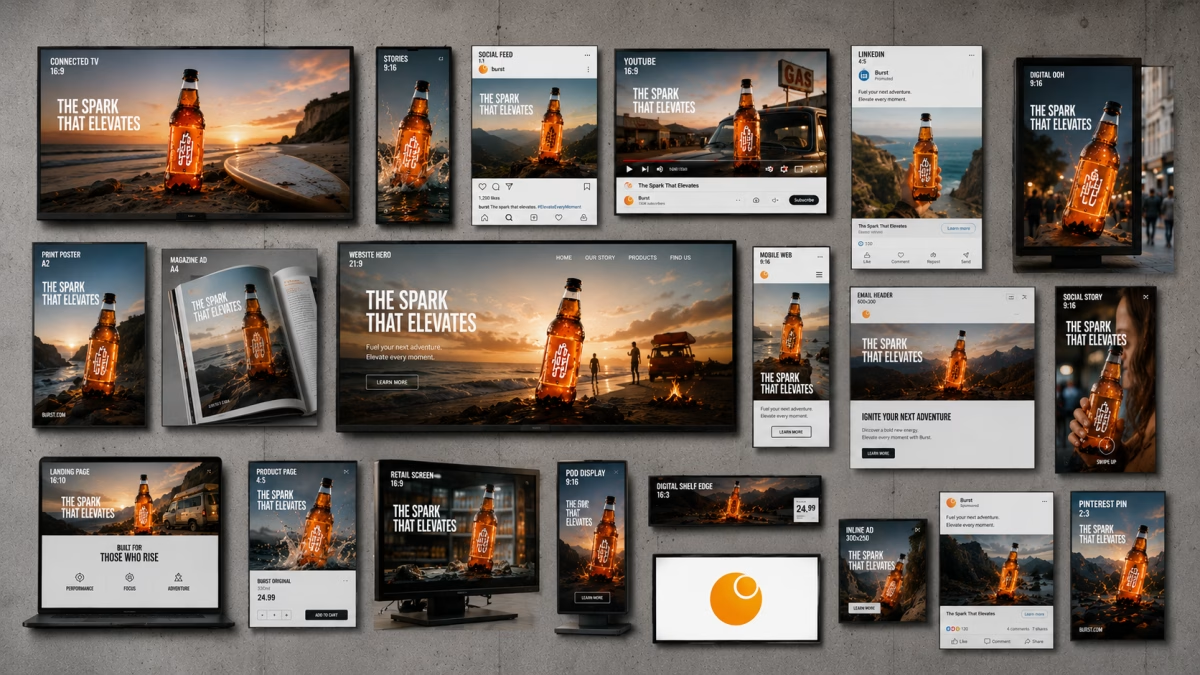
The result is an explosion in the amount of creative collateral agencies are expected to produce, as well as a much more specific set of targets that creative needs to perform against. A single campaign can require dozens, or even hundreds, of variations designed for different channels, demographics, markets, and stages of the customer journey.
More Creative Means More Decisions
Fortunately, the creative toolkit has grown alongside that demand. AI, automation, and increasingly sophisticated production tools allow agencies to develop, adapt, and iterate creative faster than ever before. Teams can explore more ideas, create more variations, and tailor executions to specific audiences without multiplying production time at the same rate.
But that creates the next challenge: the ability to produce more creative collateral also means more creative to evaluate.
Which version deserves media investment? Which opening captures attention? Does the creative resonate with the audience it was designed for? Which execution should go in front of the client? And which of the dozens of possible variations actually deserves the time and budget required to take it further?
The creative bottleneck has moved downstream. Producing the collateral is becoming faster and more scalable. Knowing which creative works, for which audience, and in which context is becoming more important.
That makes creative validation a much bigger part of the process. When agencies are producing more executions for more specific audiences across more channels, testing helps separate the creative that simply can be produced from the creative that should be backed.
At iMotions we have made it our mission to give agencies a faster way to make that distinction, using predictive AI for early directional reads, behavioral research for deeper validation, and audience benchmarking to understand performance in context.
Great advertising still begins with a great idea, that has not, nor will it probably ever, change. The challenge is, instead, knowing which execution of that great idea deserves to go further.
Start Early with Predictive AI
Let’s be perfectly honest; not every creative variation needs a full research study.
At the earliest stages of development, the priority is often speed: narrowing a large pool of ideas, identifying promising directions, and deciding where creative teams should spend their time.
Predictive AI provides that first line of testing. Creative can be evaluated quickly to get an early indication of likely attention, engagement and overall expected performance, making it possible to compare more variations while there is still time to change them.
This gives agencies a practical way to reduce a large creative field before committing production budgets or bringing respondents into the process. Weak executions can be reconsidered early, while stronger candidates move forward for further development and validation.

Predictive AI Benchmarking
For quick early-stage directional performance reads.
Validate with Real Audiences
Once the field has narrowed and the stakes increase, bring real human respondents into the process for validation of choices.
Agencies can test creative with the specific audiences it was designed to reach and collect behavioral insights alongside direct audience feedback. Rather than simply asking whether people liked an ad, teams can understand how people actually experienced it: what attracted attention, what was overlooked, where engagement changed, and how different executions performed.
That becomes particularly valuable in a fragmented media landscape. A creative developed for one demographic, market, or channel can be evaluated with the people it is actually intended for, rather than assuming that strong performance with one audience will translate to another.
The result is a clearer signal of what is working, what needs another iteration, and what is ready to move forward.

Media Analytics
For respondent-based ad testing with global benchmark context.
Put Performance Into Context
A strong result becomes considerably more useful when you know what “strong” actually looks like.
Global market and category benchmarking gives agencies another layer of context by allowing creative performance to be evaluated against relevant norms and tens of thousands of previously measured pieces of content. Instead of only knowing that version A performed better than version B, teams can understand how that performance compares more broadly.
Together, these tools create a progressive approach to creative validation: use predictive AI to move quickly through early iterations, validate promising media creative with real audiences, and benchmarking to understand the results in context.
The level of evidence grows alongside the investment in the creative.
Put Media Spend Behind Stronger Creative
The cost of a weak creative decision increases rapidly as a campaign moves toward launch.
A concept that underperforms during development is relatively inexpensive to change. Once production is complete and media has been purchased, the same discovery becomes considerably more expensive.
Testing earlier gives agencies more opportunities to identify weaker creative before significant budgets are committed and focus resources on the executions showing the strongest potential.
It does not remove risk from creative work. It helps agencies make that risk more informed.
Give Everyone Something Concrete to Decide Around
Creative decisions rarely belong to one person. Creative teams, strategists, account teams, media teams, and clients can all have a view on which direction should move forward.
Objective audience evidence gives those conversations a common reference point.
Instead of debating which creative feels strongest, teams can look at how audiences actually responded, where attention went, how executions compare, and which concepts show the greatest potential.
The data does not make the decision. It gives everyone better information to make it.
Confidence Is a Competitive Advantage
The agencies that stand out over the next few years will not necessarily be the ones producing the highest volume of creative. They will be the ones making the smartest creative decisions by validation with key audiences before launch mistakes are made
That does not mean replacing creativity with data, far from it. But it does mean giving talented creative teams better information at the moments when they need to make those crucial decisions.
It also means walking into client presentations with evidence instead of opinion, committing production and media budgets with greater confidence, and spending more time developing ideas that are more likely to succeed.
Creating more has become easy, but knowing what is likely to win is where the advantage lies.