

Try four classic cognitive tests online: the N-Back, Stroop, Sternberg, and Go/No-Go. Test your working memory, attention, reaction time, and cognitive control, and learn how these widely used tasks help researchers study the human mind.
Table of Contents
Cognitive Tests Turn Mental Processes Into Useful Data
How good is your working memory? How quickly can you ignore distracting information? And can you stop yourself from responding when your brain is already preparing to act?
Cognitive psychology has spent decades developing ways to turn questions like these into measurable experiments. Cognitive tests provide researchers with controlled ways to examine mental processes that would otherwise be difficult to observe directly.
Some of the best-known methods are surprisingly simple. Participants might be asked to remember a sequence of letters, identify the color of a word, or press a button whenever a particular stimulus appears.
Yet behind these relatively straightforward cognitive tests are carefully designed experiments that allow researchers to study processes such as working memory, selective attention, cognitive control, reaction time, and response inhibition.
Four classic examples are the N-Back Task, Stroop Test, Sternberg Task, and Go/No-Go Task. Each approaches cognition from a slightly different angle, and each has become an important experimental paradigm within cognitive psychology and behavioral science.
And if reading about cognitive tests isn’t quite enough, you can now try all four yourself on the iMotions website. Let the games begin!
The N-Back Task: Testing Working Memory
The N-Back Task is one of the most widely recognized experimental tasks for studying working memory.
The basic idea is simple. Participants are presented with a continuous sequence of stimuli, such as letters, numbers, shapes, or locations. Their job is to indicate when the current stimulus matches one presented a certain number of steps earlier.
In a 1-back task, you compare the current stimulus with the one immediately before it. In a 2-back task, you need to remember what appeared two steps earlier. A 3-back task pushes that demand even further.
The difficulty comes from the fact that the information you need is constantly changing. You aren’t simply remembering a list. You need to maintain, update, and manipulate information in working memory while new information continues to arrive.
Researchers can measure accuracy, reaction time, missed targets, and incorrect responses to investigate how performance changes as cognitive load increases.
This has made the N-Back useful in research on working memory, executive function, cognitive workload, aging, and individual differences in cognitive performance.
The Stroop Test: When Your Brain Gets in Its Own Way
Few cognitive psychology experiments demonstrate cognitive interference as elegantly as the Stroop Test.
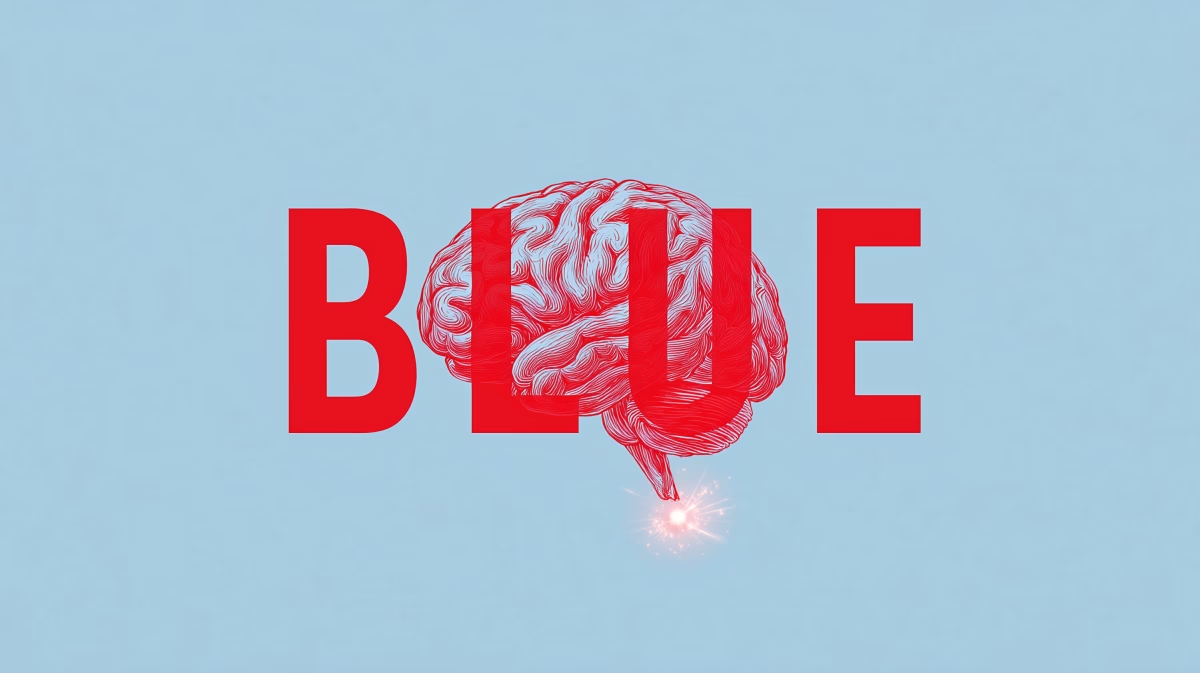
Imagine seeing the word BLUE written in red ink. Now, instead of reading the word, say the color of the ink.
It sounds easy, until you actually have to do it quickly.
Reading is such an automatic process for experienced readers that the meaning of the word interferes with the task of identifying its color. Participants are generally slower, and often more likely to make mistakes, when the word and ink color conflict.
This difference is known as the Stroop effect.
The task therefore provides researchers with a way to study selective attention, cognitive control, interference, processing speed, and inhibitory control. To give the correct response, the brain has to prioritize task-relevant information, the color, while suppressing information that is irrelevant but difficult to ignore.
The Stroop Test has become a classic demonstration of an important principle in cognitive psychology: our brains do not process every piece of information equally, and some mental processes are considerably harder to suppress than others.
The Sternberg Task: Searching Through Memory
The Sternberg Task, sometimes called the Sternberg Memory Scanning Task, examines how we retrieve information from short-term memory.
Participants are first shown a small set of items, often numbers or letters. After a short delay, they are shown another item and asked whether it appeared in the original set.
For example, you might be asked to remember:
3 – 7 – 2 – 9
You are then shown:
7
Was it part of the original set?
By changing the number of items participants need to remember and measuring their reaction time, researchers can investigate how the amount of information held in memory affects the speed of retrieval.
The original experiments by psychologist Saul Sternberg became particularly influential because reaction times increased systematically as the memory set became larger. This helped researchers develop theories about how people search information held in short-term memory.
The Sternberg Task is a good example of how something as simple as the time between seeing a stimulus and pressing a button can provide clues about mental processes that cannot be observed directly.
The Go/No-Go Task: Can You Stop a Response?
Sometimes understanding cognition isn’t about how quickly someone can respond. It’s about whether they can stop themselves from responding at all.
That’s the idea behind the Go/No-Go Task.
Participants are presented with a series of stimuli. For most of them, the Go stimuli, they need to respond quickly, usually by pressing a key or button. For another stimulus, the No-Go stimulus, they need to withhold that response.
When Go trials occur frequently, responding starts to become habitual. The No-Go trials then require participants to override that prepared response.
This makes the task particularly useful for studying response inhibition, a key component of executive function and cognitive control.
Researchers can examine reaction times on Go trials alongside errors on No-Go trials. Responding when you shouldn’t is typically called a commission error, while failing to respond to a Go stimulus is an omission error.
The Go/No-Go paradigm is widely used in cognitive psychology and neuroscience to investigate attention, impulsivity, inhibitory control, and the mechanisms involved in regulating behavior.
Four Tasks, Four Different Windows Into Cognition
Put the four tasks next to each other and their differences become clearer.
- The N-Back Task asks how effectively we can continuously update information in working memory.
- The Stroop Test examines what happens when competing information interferes with our attention.
- The Sternberg Task explores how we search and retrieve information from short-term memory.
- The Go/No-Go Task investigates our ability to inhibit a prepared response.
None of these tasks provides a complete measurement of someone’s memory, attention, or cognitive ability on its own. Human cognition is far too complicated for that.
Instead, they are experimental paradigms: controlled ways of placing particular demands on the cognitive system and measuring what happens.
And that distinction is important. Cognitive psychologists cannot simply open up the mind and watch working memory or inhibitory control happening. Instead, they manipulate a task and observe measurable outcomes such as reaction time, accuracy, error rates, and behavioral responses.
From those measurements, researchers can begin testing hypotheses about the cognitive processes underneath.
Try the Cognitive Tests Yourself
One of the best ways to understand a cognitive experiment is to experience it from the participant’s perspective.
That’s why we’ve made versions of the N-Back, Stroop, Sternberg, and Go/No-Go tasks freely available on the iMotions website.
You can try each experiment yourself, see how the task changes the demands placed on your attention and memory, and get a much more intuitive sense of why these deceptively simple experiments have remained useful tools in cognitive psychology and behavioral science.
Just don’t be too confident before trying the Stroop Test.
Your brain may have other ideas.