

What really happens in the first 500 milliseconds after you see something new? Before you’re consciously aware of it, your brain has already detected faces, tracked movement, and decided where to look next. Explore the neuroscience of rapid perception, eye tracking, and why timing matters as much as attention itself.
Table of Contents
Anyone who has read anything on this website before, or has even a passing interest in neuroscience, already knows that the human brain is nothing short of extraordinary. Aside from being the only organ that named itself, it is arguably the most sophisticated information-processing system we know of.
Every second, your eyes deliver millions of bits of visual information to your brain. Your conscious mind experiences only a tiny fraction of it, because the brain simply cannot process everything in detail. Instead, it has evolved to make incredibly rapid decisions about what deserves attention and what can safely be ignored.
Much of this happens before you are even aware of it.
Within the first 500 milliseconds of seeing a new scene, your brain has already detected edges, recognized faces, identified movement, begun interpreting objects, and decided where your eyes should look next. These first few hundred milliseconds influence what you notice, what you remember, and ultimately how you interact with the world around you, which is exactly why they represent one of the most fascinating windows into human cognition for neuroscientists and behavioral researchers alike.
Before Conscious Attention
It often feels as though we consciously choose what catches our attention. In reality, the brain gets a considerable “head” start (pun very much intended).
Every visual scene contains vastly more information than the brain can analyze simultaneously. Instead of treating every detail equally, the visual system rapidly identifies features that might be important. Bright colors, sudden movement, high contrast, human faces, text, and unexpected objects all compete for processing.

This initial stage is known as bottom-up attention. Rather than reflecting conscious decisions, it is driven by the properties of the stimulus itself. This system has been shaped by evolution to prioritize information that could matter for survival. Faces, sudden movement, and unexpected events were often worth noticing first, and those same neural mechanisms continue to guide our attention today.
Only afterward do top-down processes begin to take over. These are shaped by our goals, expectations, and memory. If you’re searching for your car keys, your brain quickly starts prioritizing objects that resemble keys while filtering out countless irrelevant details.
What Happens Inside the Brain
Researchers often refer to “the first 500 milliseconds” as though it were one event, but it’s actually a fast-moving relay, with different neural systems handing off to one another in sequence.
| 0–50 ms | Light reflected from the world reaches the retina, where photoreceptor cells convert it into electrical signals that travel through the optic nerve toward the brain. |
| 50–100 ms | The signals arrive in the primary visual cortex (V1), where the visual system begins extracting the raw building blocks of an image: edges, orientation, contrast, color, and simple motion. |
| 100–200 ms | Information spreads through specialized visual pathways that begin recognizing faces, objects, text, and movement – still largely bottom-up processing. This is roughly the window in which research using rapid-presentation paradigms has found the brain can already begin distinguishing categories like “animal” from a briefly flashed image, and in which face-selective neural responses typically peak. |
| 200–300 ms | The brain starts combining incoming visual information with memory and prior experience. Object recognition sharpens, allowing familiar people, places, and objects to be identified. |
| 300–500 ms | Top-down attention increasingly takes the wheel. Rather than responding only to what stands out visually, the brain begins directing attention according to current goals and intentions. Conscious awareness of the scene becomes noticeably richer, though processing, of course, continues well beyond the half-second mark. |
Perception, in other words, is not a single event. It’s a cascade, with different brain regions contributing at different moments – bottom-up first, top-down close behind.
Why 500 Milliseconds?
There is nothing magical about the number itself. Researchers use this window because it captures the earliest stages of visual processing, before conscious reasoning and top-down goals have had much time to take over. Many of the neural signals most associated with early perception, such as feature extraction, initial object recognition, the first shifts in attention, cluster inside it. This makes it a practical boundary for studying how vision begins, before it gets tangled up with deliberate thought.
The Eye Never Stops Moving
Although it feels as though we continuously observe the world, our eyes are constantly in motion. Several times a second, they perform rapid jumps called saccades, shifting from one point of interest to the next. Between these jumps, the eyes briefly settle into fixations, typically 200 to 300 milliseconds long, and it’s during these brief pauses that most detailed visual information is actually gathered.
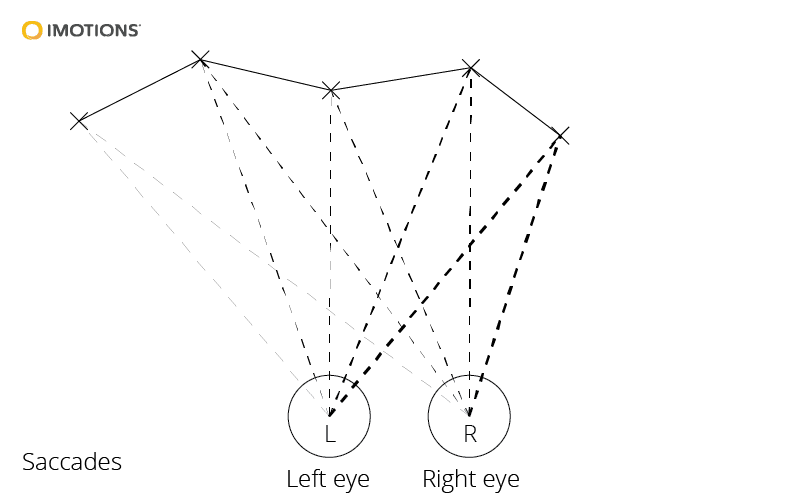
Eye tracking lets researchers measure not just where people look, but the sequence in which they look, revealing how attention unfolds from the very first moments of perception, and giving direct, observable form to the bottom-up/top-down handoff described above.
Duration Isn’t the Whole Story
Many studies summarize attention by reporting total viewing time: how long someone looked at a webpage, a product package, an ad, an interface. But duration only tells part of the story.
Two designs can produce nearly identical total viewing times while generating very different patterns in the opening moments. One might immediately guide the eye toward the most important information; another might only succeed after several seconds of aimless exploration. For a lot of research questions, when attention lands somewhere is just as informative as how long it stays.
Attention Isn’t Preference
Early attention shouldn’t be confused with liking or engagement. People readily notice visual errors, flashing lights, or unusual objects, simply because these are visually salient, not because they’re enjoyable or persuasive.
That’s why behavioral researchers increasingly pair eye tracking with complementary measures: facial expression analysis, physiological signals, EEG, and self-report. Attention tells you where processing begins. The other measures help explain what happens next, and why.
Measuring the Brain’s First Response
The first 500 milliseconds unfold far too quickly for people to describe accurately afterward. Ask someone what first caught their attention, and they’ll likely give a thoughtful, confident answer, but that answer reflects what they remember, filtered through recall and narrative, not necessarily what actually happened in those first few hundred milliseconds.
This is why behavioral measurement matters a lot. Eye tracking can reveal where attention is directed in real time, EEG records neural activity with millisecond precision, and physiological signals like skin conductance and heart rate add insight into emotional and cognitive processing alongside it. Together, these methods let researchers study perception as it unfolds, rather than relying on memory after the fact.
A Tiny Window Into Human Cognition
Every time you encounter something new, your brain starts making decisions before you’re consciously aware of them. In the first 500 milliseconds, visual systems extract raw features, attentional networks decide what deserves priority, and memory begins shaping interpretation.
None of this determines every decision that follows. Perception is still shaped by motivation, context, and experience further down the line (top-down processing), but it does establish the foundation everything else is built on. Information that’s never noticed in those first few hundred milliseconds has little chance to influence memory, judgment, or behavior later.
For neuroscientists, psychologists, educators, and behavioral researchers alike, that half-second remains one of the clearest windows we have into how the brain turns raw light into meaningful experience.
References
Bentin, S., Allison, T., Puce, A., Perez, E., & McCarthy, G. (1996). Electrophysiological studies of face perception in humans. Journal of Cognitive Neuroscience, 8(6), 551–565.
Itti, L., & Koch, C. (2001). Computational modelling of visual attention. Nature Reviews Neuroscience, 2(3), 194–203.
Rayner, K. (2009). Eye movements and attention in reading, scene perception, and visual search. The Quarterly Journal of Experimental Psychology, 62(8), 1457–1506.
Thorpe, S., Fize, D., & Marlot, C. (1996). Speed of processing in the human visual system. Nature, 381, 520–522.
National Eye Institute (NIH) — “How the Eyes Work.” Accessible overview of retinal phototransduction and the optic nerve pathway, suitable as a general-audience reference for the 0–50 ms stage.