



Abstract: This research fills a gap in the literature regarding face-to-face privacy invasions. Most research in the privacy arena examines information privacy (e.g., credit card and data information) and ignores the privacy component of face-to-face interactions. Using three studies, the authors explore the impact of physical and visual invasions on privacy control. The findings show that only one dimension of privacy needs to be invaded for consumers to feel less control over their privacy. Perceptions of privacy control have a negative relationship with satisfaction, as mediated through feelings of anxiety. Importantly, two invasions do not have a greater impact than one, and a legitimate reason for physical or visual invasions can lessen the negative consequences in terms of anxiety and satisfaction. These results have important theoretical and practical implications for marketers aiming to design satisfying consumption experiences that also preserve consumer welfare.

Related Posts
-

How to Study Indoor Wayfinding: What People Notice, Where They Struggle, and What to Measure
-

Human-in-the-Loop Digital Twins: How Real-Time Biosensor Data Is Transforming Simulator Research
-
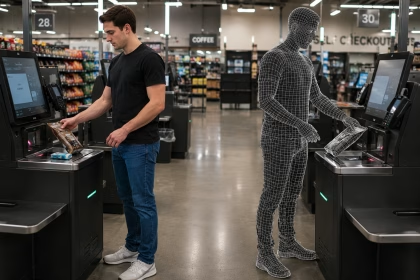
Digital Twins in Consumer Research: Validating Synthetic Behavior with Biosensors
-

What Happens in Flow, and How Do We Capture It?