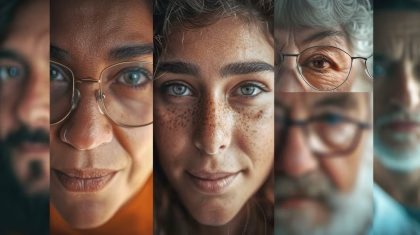
Cloud-based remote biometric research provides real-time facial, gaze, and sensor data to strengthen consumer insights and enhance UX evaluations.
Table of Contents
Traditional behavioral research often relies on controlled environments to test specific hypotheses. Although this approach does yield valuable insights, it can also obscure important aspects of natural behavior. Remote biometric research addresses this by allowing participants to remain in familiar settings. In such environments, people are more likely to behave authentically rather than altering their behavior in response to the awareness of being observed in a laboratory setting.
This is the revolution of remote biometric research. It’s a fundamental shift, powered by modern remote data collection. We’re no longer bringing people to the technology. We’re bringing the technology to the people. And it’s changing everything we thought we knew about human behavior.
Let’s break down how this new wave of cloud-based data collection is reshaping the world of consumer and UX insights.
From the Lab to the Living Room: Why Context is King
Think about the last time you shopped online. Were you leaning forward, focused? Or lounging on the sofa, distracted? Your mental state changed everything. What you clicked. What you bought. How did you feel?
In-lab studies miss this crucial context.
Remote biometric research closes that gap. It uses a person’s own devices, their laptop, their webcam to capture data where decisions naturally happen, making data collection convenient for all parties involved.
- You get real-world reactions, not performative, “being-watched” behavior.
- You access a global audience overnight, without travel costs or logistics.
- You gather data at scale, improving reliability and research credibility.
The results will yield more authentic insights.

The Toolkit: Measuring the Unspoken, Remotely
So, how does remote biometric research actually work? Modern platforms have turned sophisticated sensors into everyday tools.
Webcam Eye-Tracking is a game-changer. It shows exactly where a person looks, where they get stuck, and what they ignore completely. You can see if they truly read the disclaimer or just skimmed it. You can watch their gaze dance across a new website layout, all through their standard computer camera.
Facial Expression Analysis decodes emotions. It reads the minute movements of the muscles of the face. A flash of impatience in case a page takes too long to open. One of the moments of happiness upon discovering an ideal product. This is gold for UX and marketing teams. It tells you what people feel but would never say in a survey.
And there’s more. We can measure emotional arousal through a mouse-like sensor called Electrodermal activity (EDA). We can even gauge cognitive workload by how someone interacts with their keyboard.
The magic happens when you combine these streams. Seeing that a user looked at the “buy” button (eye-tracking) while frowning (facial expression) and their stress spiked (EDA) tells a complete story. A story you can now capture from thousands of people at once.
The New Research Playbook: Speed, Scale, and Depth
This isn’t just a minor upgrade. It’s a complete rewrite of the research playbook with remote biometric research.
Speed is everything. A study that took six months from planning to report can now be done in weeks. You can test a new ad concept on Monday, analyze the biometric data on Wednesday, and have actionable insights for your creative team by Friday. This pace was unthinkable just a few years ago.
Scale changes the game. Instead of 40 participants from one city, you can have 400 from four continents. This diversity demonstrates cultural peculiarities and ways of use, of which you would otherwise have been uninformed. Your data is not merely more profound, but broader and more representative.
The depth of insight is profound. You move beyond “what” people do and into “why” they do it. You’re not just asking them to recall their experience; you’re measuring it as it happens. This is the key to building products people love and campaigns that truly resonate.
A Real-World Glimpse
Take the example of a streaming service that was interested in knowing why users were quitting on a show after episode one. A traditional survey might have yielded vague answers. “It was boring.” Not helpful.
A remote biometric research study told a different tale. Using webcam eye-tracking and facial expression analysis, they discovered a key insight. During the critical first ten minutes, a distracting and complex opening credits sequence was causing widespread confusion and a drop in engagement. Viewers weren’t bored. They were lost. This was a fix the team could never have diagnosed with a questionnaire.
Navigating the Future Responsibly
Of course, this power comes with responsibility. Collecting data remotely requires a fierce commitment to privacy.
Informed consent is non-negotiable. Participants must know what data is being collected, how it’s used, and how it’s protected. Anonymization is critical. Raw video should never be stored. Only the anonymized, aggregated metrics of the data points should be used for analysis. Trust is your most valuable asset, and it’s built on transparency.
The future of understanding people is unfolding in their own space. Remote biometric research is authentic, scalable, and incredibly powerful. We are no longer limited by geography or artificial environments. We can finally listen to what people’s bodies are telling us, in the places where it matters most.
Ready to see the human response in its natural habitat?