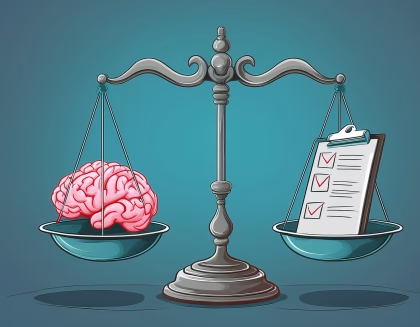
Voice analysis modules reveal hidden customer emotions through tone, pace, and stress, helping brands understand intent and improve customer insight.
A customer tells a support agent, “That’s fine, whatever you think is best.” The words seem agreeable. On paper, it looks cooperative. But you hear it. The tight, clipped tone. The slight sigh. A story of simmering frustration is happening right beneath the words. If you only read the transcript, you missed the entire crisis.
We have spent decades listening to what people say. Surveys. Reviews. Focus group notes. It’s a mountain of text. But it’s just the surface. The real story isn’t in the dictionary definitions. It’s in the music of the voice. The emotion. The stress. The genuine intent. It is a hidden layer of human experience, waiting to be heard. By analyzing how customers speak rather than just what they say, speech data uncovers insights that remain invisible in text based analysis alone.
This is the new frontier. This is where Voice Analysis Modules change everything. This technology listens to the human voice in a completely new way. It goes beyond words to decode the truth of how people feel. Let’s dive in. Let’s see how listening differently reveals a goldmine of insight.
So, what is a Voice Analysis Module?
Forget complex jargon for a moment. Think of it like this.
A transcript tells you the “what.” A Voice Analysis Module tells you the “how.”
It’s smart software that listens to the parts of speech we feel but don’t name. The parts that aren’t words at all. It completely ignores the dictionary meaning. Instead, it focuses on the music and rhythm of the voice itself.
What does it actually measure? Things like:
- Tone and Pitch: Hear all the excitement in a voice. Or sinks with disillusionment.
- Pace and Rhythm: Listen to the words begin to run with anxiety. Or creepingly, with deliberation slows.
- Energy and Volume: It is possible to project confidence in a voice. Or it may die out, doubtful.
- Articulation: Are the words clear and crisp? Or are they whispering and stammering?
By tracking these cues, the module gives you objective data. It measures emotional state. It spots cognitive load. It reveals levels of stress or engagement that words alone can hide.
Why this matters: Three real-world wins
This isn’t just theory. It’s closing the giant gap between what people say and what they actually experience.
1. The Customer Service Game-Changer
Every call center records calls. Most just scan transcripts for keywords like “cancel” or “angry.” But what about the customer who never says those words? A Voice Analysis Module hears the rising frustration in their tone. It can flag that call instantly. A supervisor can jump in live or make an urgent follow-up. This saves a customer from leaving. It also finds your best agents. Not the fastest talkers, but the ones whose calm, empathetic tone genuinely de-escalates tension.
2. Market Research’s Secret Weapon
A focus group is talking about a new product. The transcript looks great. Everyone says they “like it.” But the voice data paints a different picture. Their words are positive, but their tonal energy is completely flat. No real excitement. This “tonal disconnect” is a massive red flag. Itreveals a polite but unenthusiastic response that won’t lead to sales. Now, the researcher knows to dig deeper. They might have just saved a product from a failed launch.
3. Catching Hidden UX Problems
You’re testing a new app. A user is trying to find a button. They’re talking, saying, “I’m looking for the button… okay, I think I found it.” Their words are neutral. No big deal. But the voice analysis shows a sharp spike in hesitation right before they succeed. That spike pinpoints a moment of confusion. A UX flaw that the user couldn’t even put into words. You found a critical problem that a transcript would have missed completely.
How can you start listening to the hidden layer?
Getting started is straightforward. It’s more about smart software than fancy hardware.
Here is a simple, practical approach:
- Find your key question. Start with one big problem. Do you want to improve customer satisfaction? Make better ads? Find hidden website friction?
- Use what you already have. A modern Voice Analysis Module, like the one in the iMotions platform, works with audio you have already recorded. Use call center data. Focus group recordings. Lab sessions.
- Combine your data. This is where the magic happens. Don’t just listen. Combine voice with other metrics. Imagine seeing a user’s voice stress spike at the same time their physiological arousal jumps. That’s a powerful, undeniable insight into the human response.
The bottom line
Relying only on words is like reading a book with half the pages missing. You get the basic plot. But you miss the emotion. The subtext. The character’s true drive.
A Voice Analysis Module finds those missing pages.
It gives you a deeper, more honest understanding of your customers. It moves your research from analyzing what was said to understanding what was truly meant.
Ready to hear the whole story?
Explore how iMotions brings it all together. See how our platform, with its Voice Analysis Module, helps you move beyond the words. It’s time to unlock complete human understanding.