

Abstract Facial expression has been proposed as a key mechanism in forming and maintaining social relationships. Humans have particularly expressive faces, but direct evidence linking individual level expressivity to group-level social bonding is limited. Here we examined whether spontaneous facial expressivity impacts social popularity during initial group formation. Participants (72 groups, N = 256) engaged in unstructured online interactions in small groups with strangers during which facial behaviour was quantified using automated analysis. Social popularity was measured by calculating social network indices based on relative liking. More facially expressive individuals were rated as warmer and more cooperative, and occupied more central positions in the group social network. In contrast, facial attractiveness did not predict social standing. These findings support the hypothesis that facial expressivity functions to promote cooperative relationships during group formation.

Related Posts
-

Combatting Fraud in Online Surveys: What To Do When Your Respondents Aren’t Real
-

Human-in-the-Loop Digital Twins: How Real-Time Biosensor Data Is Transforming Simulator Research
-

Digital Twins in Consumer Research: Validating Synthetic Behavior with Biosensors
-
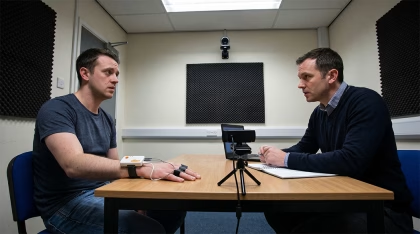
Forensic Science: Leveraging Human Behavior Research to Go Beyond the Crime Scene