

Human Factors
Health and Wellbeing Research
Measure the real impact of environments on stress, resilience, and wellbeing with objective biosensor data – turning human insights into actionable interventions that support healthier, more productive experiences.

















Measure Health and Wellbeing Beyond the Absence of Disease
Nearly 1 in 2 people globally report experiencing significant daily stress, highlighting the urgent need to better understand how environments, workloads, and experiences shape human wellbeing. Yet traditional surveys alone often fail to capture the full picture.
iMotions enables researchers to objectively measure human wellbeing across physical, mental, and emotional dimensions using synchronized biosensor data – including heart rate variability, brain activity, physiological arousal, and more.
By revealing hidden patterns in stress, cognitive load, and physiological strain in real time, iMotions empowers researchers to evaluate interventions, design healthier environments, and develop data-driven strategies that improve resilience, performance, and overall quality of life.

1 in 3 adults report feeling overwhelmed by stress most days.
76% of workers report at least one symptom of burnout during their careers.
12 billion workdays are lost every year due to depression and anxiety worldwide.
70% of people say work stress negatively affects their physical or mental health.
Measure Real Human Responses with Integrated Health and Wellbeing Research Software
The iMotions platform enables researchers to uncover the physiological and emotional drivers of health and wellbeing through advanced biosensors, seamless data analysis, and ready-to-present visualizations.

Measure Cognitive Load and Mental Fatigue
EEG (Electroencephalography) monitors brainwave activity to assess cognitive load, mental fatigue, and stress-related brain patterns. This helps researchers evaluate workload and optimize tasks for improved mental clarity.

Track Physiological Stress Responses
ECG (Electrocardiography), measures heart rate variability (HRV) to monitor cardiovascular stress, while GSR (Galvanic Skin Response) detects emotional arousal. Respiration sensors assess breathing patterns, helping to identify stress-induced changes and guide relaxation strategies.

Visual Attention Analysis
Eye tracking evaluates visual attention, fatigue, and stress, both in controlled environments and natural settings. This helps researchers understand visual strain and optimize environments to reduce fatigue.

Emotional State Detection
Facial expression analysis identifies emotional strain, while voice analysis evaluates tone, pitch, and cadence for insights into stress and mood, enabling tailored interventions.

Advanced Survey Tools
Capture self-reported feedback and seamlessly align it with biosensor data for a more complete view of health and wellbeing research

Data Visualization and Analysis
The platform simplifies the interpretation of complex data, offering intuitive visualization tools that help assess physiological, cognitive, and emotional wellbeing, leading to informed interventions that promote overall health.

APIs & Integrations
iMotions Lab is designed for multimodal research, allowing easy synchronization of data from multiple sources. With support for third-party hardware, built-in event APIs, and LSL, it offers extensive integration possibilities.
Mindfulness meditation can reduce stress levels by up to 30%
Employees in supportive work environments report 32% lower burnout
Regular yoga practice reduces anxiety symptoms in about 40% of participants in clinical studies
Mindfulness-based interventions significantly improve mental health in nearly half of participants.

Evaluate Interventions and Initiatives that Support Health and Wellbeing
Understand which strategies truly improve resilience, recovery, and mental health.
Researchers and practitioners are exploring a wide range of interventions to improve health and wellbeing, from mindfulness meditation and yoga to workplace design changes and targeted mental health programs.
Understanding how these interventions affect stress, recovery, and cognitive performance is essential for creating effective strategies that support resilience, reduce burnout, and promote sustainable physical, mental, and emotional wellbeing.
Looking for a quote for a grant or project?
Our experts support researchers with tailored quotes and grant-ready documentation. We make it easier to align iMotions solutions with your funding requirements.
Applications in Health and Wellbeing Research
iMotions Lab can be tailored to your specific Health and Wellbeing research focus, whether in human factors, occupational health,
or wellbeing research.

Stress Assessment Across Diverse Contexts
iMotions Lab uses EEG, ECG, and GSR to measure stress responses across diverse environments, enabling interventions that improve wellbeing and decision-making.

Workplace Wellbeing Optimization
Eye tracking, EMG, and ECG help researchers measure workplace strain and design environments that reduce fatigue, improve comfort, and support employee wellbeing.
Cognitive Load Measurement for Mental Wellbeing
Using EEG and eye tracking, researchers can measure cognitive load during complex tasks, helping to reduce mental strain, enhance wellbeing, and optimize workflows in demanding environments.

Monitoring for Mental Health Support
Facial and voice analysis reveal emotional states and early signs of mental health challenges, enabling interventions that support resilience and employee wellbeing.

Employee Wellbeing and Engagement Programs
iMotions Lab combines ECG, facial expression, and voice analysis to measure stress, engagement, and wellbeing at work – helping organizations design programs that reduce burnout and improve job satisfaction.
iMotions Health and Wellbeing Research Software Solution
iMotions Lab
Advanced, fully customizable research platform
Design rigorous, fully customizable health and wellbeing studies in the lab, workplace, healthcare settings, or real-world environments.
iMotions Lab is built to support research into stress, mental health, fatigue, cognitive load, and human resilience – where precision, flexibility, and synchronized multimodal data are essential for understanding the full picture of wellbeing.
iMotions Lab offers:
- Eye tracking (screen-based, glasses, and VR)
- EEG, EMG, ECG, GSR/EDA, and fNIRS integration
- Facial expression and voice analysis for emotional state assessment
- Physiological monitoring of stress, fatigue, and cognitive workload
- Advanced stimulus presentation for behavioral and cognitive research
- Centralized synchronization of physiological, behavioral, and cognitive signals
- Custom hardware integrations and LSL support
To learn how iMotions Lab enables advanced, multimodal health and wellbeing research, contact us.
No commitment. Quick walkthrough. See if iMotions Lab fits your research needs.
Support and Training
All iMotions customers have a dedicated Customer Success Manager who is ready to guide in getting the most out of the software and hardware.
Consultation & Demo before buying
We always make sure you are getting the right setup for your needs
Help center and Dedicated Support
Extensive help center with easy to follow articles and on-call product experts all days of the week.
Consultation
Personalized onboarding, training, and consulting for the entire research process.
iMotions Academy
Become Certified in using iMotions in our 5 day intensive academy.
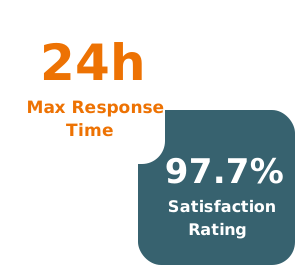
Our support staff works out of Copenhagen and Boston and have extensive experience using iMotions for research.
Ready to Transform Your
Health and Wellbeing Research?
We believe in personal and dedicated customer service and would love to hear about your project, or even just challenges you have that you would like to overcome with the use of better software.
Publications
See publications from our user base of leading researchers
Blog
Read about Health and Wellbeing themes on our blog
Case Studies
See how others use iMotions to power their research labs and achieve unparalleled research efficiency