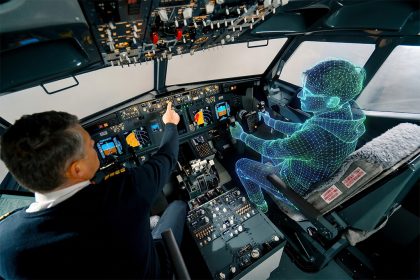
Present study on cognitive workload in driving focuses on reduction of workload for better driving performance. In this paper, we talk about the cognitive load in drivers of autonomous cars and their performance under multiple cognitive loads. Our previous studies have indicated that low to no workload is likely to induce drowsiness in drivers of autonomous vehicles. We hypothesize that there is an optimal cognitive load for a driver during autonomous driving for best performance after transfer of control from autonomous to manual. We propose an experiment to study the cognitive load on the driver of a simulated autonomous car and the effects on manual driving performance. We also describe our use of biometric devices to obtain physiological measures indicative of cognitive workload.
Other publications you might be interested in
-
2026 Strategic Business Research Open Access Peer-Reviewed
MarTech and Neuromarketing into Entrepreneurship Capstones: An Empirical Study on Experiential Learning Outcomes
Amity University Jharkhand + 1 more
-
2026 Gated
The Influence of Tutor Engagement, Attention, and Positive Emotions on Student Achievement
Vanderbilt University
-
2026 Plos One Open Access Peer-Reviewed
Characterizing multidimensional facial synchrony for relationship quality detection
Leuphana Universitat Luneburg, GERMANY
-
2026 International Journal of Hospitality Management Gated Peer-Reviewed
Designing smart menus: A multi-method exploration of AI integration in hospitality guest experience and operations
Isenberg School of Management + 1 more
-
2026 Journal of Nonverbal Behavior Open Access Peer-Reviewed
The Face of Trypophobia: An Exploratory Analysis of Facial Expressions in Response to Trypophobic Objects
-
2026 International Journal of Human–Computer Interaction Open Access Peer-Reviewed
Technostress-Aware Integrated Development Environments (TIDEs): A dataset for exploring technostress during programming
Birmingham City University + 1 more