
Discover 10 key areas where simulation research reveals deep behavioral insights, from aviation and surgery to AI systems, showing how controlled environments advance human behavior science.
Table of Contents
Exploring How Controlled Environments Advance Human Behavior Science
Simulation research has evolved into one of the most powerful methodological frameworks in modern behavioral science. It occupies a unique space between laboratory control and ecological validity. Unlike static tasks, simulation environments are dynamic systems: they unfold over time, respond to user input, introduce uncertainty, and generate consequence.
This temporal and interactive dimension makes simulation uniquely suited for studying how humans behave under pressure, under uncertainty, and in coordination with technology and other humans.
Below, each of the ten domains is expanded in depth – illustrating not only what can be studied, but why simulation uniquely enables those insights.
1. Automotive: The Psychology of Attention, Risk, and Automation
Modern automotive simulation has become a behavioral laboratory for studying the evolving relationship between humans and semi-autonomous systems.
One of the most pressing research questions concerns attention allocation. Driving is a distributed cognitive task: it requires visual scanning, predictive modeling of other agents, motor coordination, and constant risk assessment. Simulation enables controlled variation of traffic density, weather, pedestrian unpredictability, and dashboard complexity. These manipulations reveal how attentional bandwidth is allocated and how quickly it collapses under secondary task load.
Automation introduces an additional layer: trust calibration. Over-reliance leads to complacency and delayed intervention. Under-reliance leads to unnecessary override and reduced efficiency. Simulation allows researchers to measure takeover reaction times, gaze reorientation latency, and physiological arousal during sudden system disengagements. Crucially, rare but dangerous events, such as abrupt obstacle emergence, can be safely reproduced multiple times to examine consistency of response.
The result is a deeper understanding of how humans supervise automation, not in theory, but in unfolding real-time scenarios.
2. Aviation: Expertise, Fatigue, and Distributed Cognition
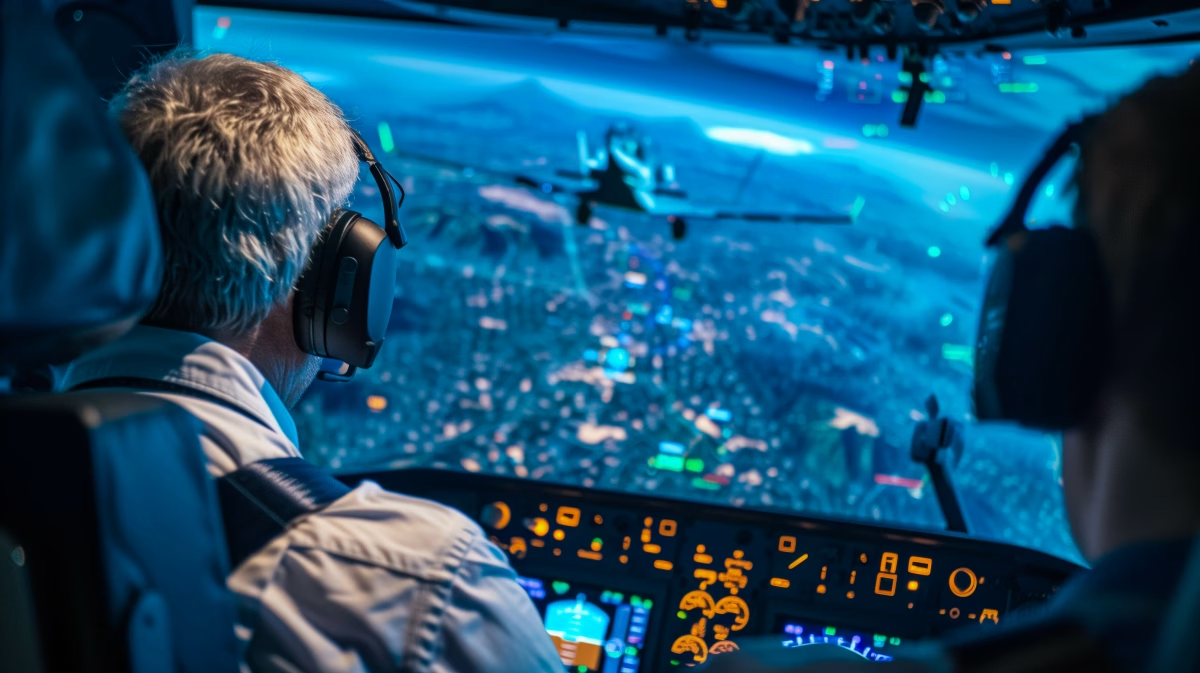
Aviation simulation offers unparalleled access to the cognitive architecture of high-reliability performance.
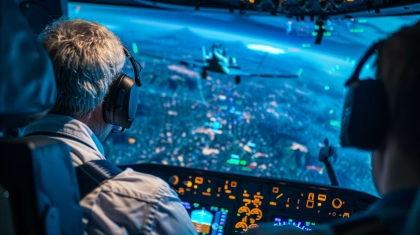
Flight decks are dense with information. Instrument scanning patterns reveal structured expertise: experienced pilots exhibit systematic, efficient gaze loops, while novices display fragmented scanning and fixation on salient but less diagnostic cues. Simulation allows repeated exposure to identical failure scenarios, enabling comparison across experience levels.
Fatigue research also benefits from simulation’s temporal flexibility. Long-haul conditions can be replicated, allowing study of vigilance decline, micro-lapses, and delayed error detection. Physiological measures combined with performance metrics illuminate the subtle degradation of cognitive resilience before overt failure occurs.
Aviation simulation further enables investigation into crew resource management. Decision-making is rarely individual; it emerges from dialogue, shared mental models, and hierarchical dynamics. By manipulating communication clarity, workload asymmetry, or ambiguous alarms, researchers gain insight into how teams maintain – or lose – coherence under stress.
3. Maritime Navigation: Sustained Vigilance and Environmental Uncertainty
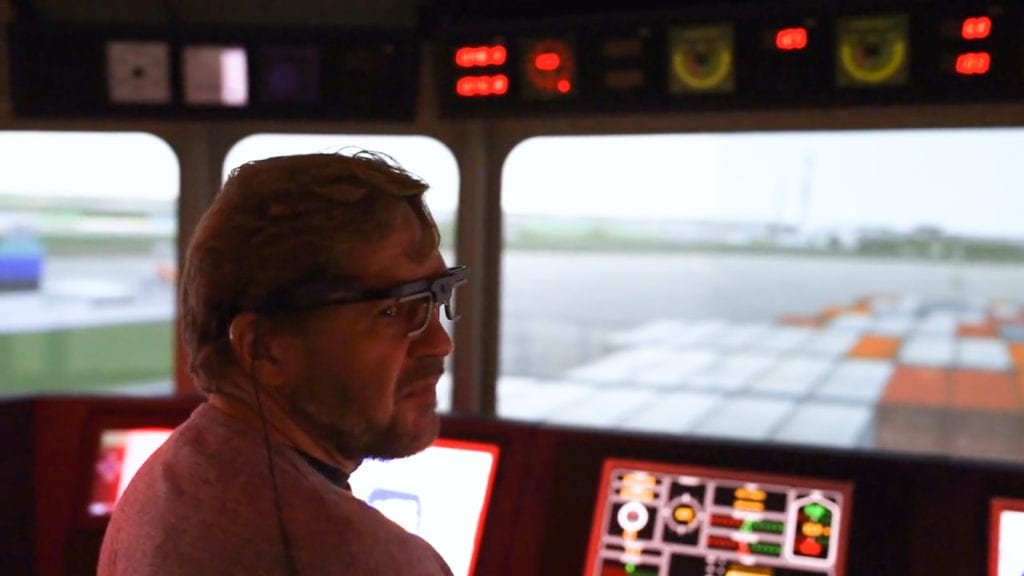
Maritime contexts differ fundamentally from aviation in temporal structure. Decisions often unfold over extended durations, requiring prolonged vigilance punctuated by critical maneuvers.
Bridge simulators allow replication of fog, high-traffic straits, equipment malfunction, and shifting currents. Unlike retrospective incident analysis, simulation enables controlled experimentation on near-miss events.
Researchers can investigate how fatigue accumulates during extended watch periods, how attention narrows during collision risk, and how automation reshapes operator monitoring behavior. The gradual degradation of situational awareness, rather than sudden failure, is often the key behavioral variable.
Simulation also supports analysis of team coordination across bridge crew members, revealing how information sharing patterns influence safety margins.
4. Surgery: Cognitive Load, Precision, and Error Recovery
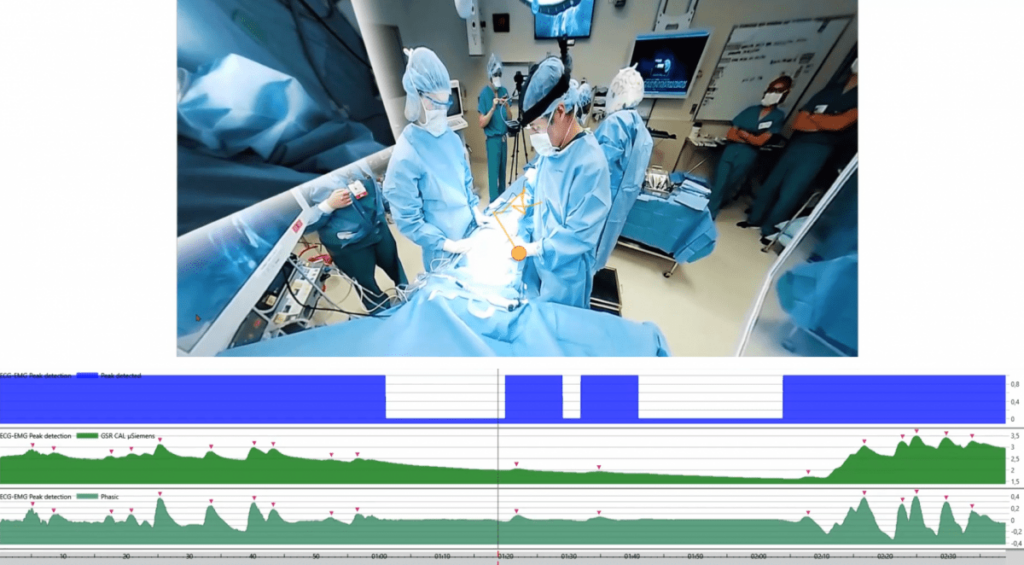
Surgical simulation offers a rare opportunity to examine the interplay between cognition and fine motor control.
Minimally invasive procedures demand precise hand-eye coordination under constrained visual feedback. Simulation platforms allow micro-level performance tracking: instrument path smoothness, error rates, time-to-completion, and gaze fixation stability.
Beyond motor performance, simulation reveals cognitive workload dynamics. Introducing unexpected bleeding events or equipment malfunctions allows study of how stress impacts procedural memory retrieval and decision speed.
Team-based medical simulations further illuminate communication breakdowns and leadership emergence during emergency escalation. These insights extend beyond training; they inform OR design, workflow protocols, and ergonomic adjustments.
5. Emergency Response and Crisis Management
Crisis fundamentally alters cognition. Under acute stress, attentional narrowing, heuristic reliance, and altered time perception emerge.
Simulation makes it possible to systematically vary hazard intensity and unpredictability. For example, fire spread speed, structural collapse probability, or victim location ambiguity can be manipulated to observe decision thresholds.
Researchers gain insight into how stress affects risk trade-offs, communication clarity, and adherence to protocol. Because real disasters cannot be experimentally induced, simulation becomes the only ethical pathway to studying high-stakes behavioral adaptation.
6. Military and Defense: Adaptive Trust and Tactical Reasoning
Military simulators recreate environments characterized by uncertainty, incomplete information, and adversarial dynamics.
Modern defense research increasingly focuses on human–AI teaming. When autonomous drones or decision-support systems generate recommendations, how do operators weigh machine input against intuition? Simulation allows iterative exposure to varying AI reliability levels, revealing how trust is calibrated, or miscalibrated, over time.
The insight here is not simply reaction speed, but adaptive strategy formation under uncertainty.
7. Industrial Operations and Energy Systems
Industrial control rooms and manufacturing environments present complex monitoring demands. Simulation enables replication of alarm cascades, equipment failure, and maintenance procedures without disrupting real operations.
Researchers examine alarm fatigue, attention tunneling, and prioritization strategies. Digital twin environments allow testing of workflow modifications before real-world deployment, identifying cognitive bottlenecks and safety vulnerabilities.
8. Urban Planning and Smart Mobility
Virtual urban environments allow researchers to model pedestrian density, signage clarity, and environmental stressors such as noise and lighting.
Wayfinding decisions, route selection, and stress responses can be studied before infrastructure is physically built. Simulation provides a bridge between architectural theory and behavioral reality, revealing how environmental design shapes cognitive mapping and navigation efficiency.
9. Complex Interfaces and Human–Computer Interaction
Simulation environments are invaluable for testing control-room dashboards, financial trading systems, and cybersecurity monitoring platforms.
By introducing time pressure and information overload, researchers observe how users prioritize data streams, detect anomalies, and recover from interface confusion. These findings inform interface simplification and decision-support design aligned with human perceptual limits.
10. Rehabilitation and Neuropsychological Recovery
Simulation supports graded exposure therapy, motor retraining, and cognitive rehabilitation within controlled, adaptive environments.
For stroke recovery, virtual tasks can progressively increase motor complexity. For PTSD, simulated exposure can be titrated to individual tolerance levels. Researchers can measure behavioral adaptation longitudinally, mapping recovery trajectories with precision.
The Broader Implication
Across these domains, simulation transforms behavioral science from static observation to dynamic system analysis. It allows rare events to be studied repeatedly, complex variables to be isolated, and high-risk environments to be ethically reproduced.
In an era increasingly defined by automation, AI integration, and complex socio-technical systems, simulation is becoming not just a research tool, but the foundation for understanding how humans operate within layered technological ecosystems.
Interested in more Simulation Research from iMotions?