

In the last decades, several studies have highlighted the importance of emotions in the teaching and learning process. The classroom is considered as an emotional place, where the learning is influenced by cognitive and emotional-motivational mechanisms. Classically, emotions have been classified in seven basics categories. Furthermore, in educational settings, it is possible to evaluate other categories as engagement and attention. According with this vision, we designed an activity to analyse emotions and their flow when students are involved an inquiry-based activity. To avoid the biases in self-reports and the perceiver- dependent limitations of observational methods, we evaluated emotions with an automatic facial coding system. This system detects facial human expressions using facial reference points, and classifies their emotional value parametrically. The data shows different flows for each emotion. Thus, we observed a high level of attention’s flow along the whole activity and a constant engagement of the participants. On the other hand, the joy and surprise flow are more variable, with highest values at the beginning and lower at the end. The negative emotions as anger, sadness, disgust, fear, and contempt are very low. This work opens to the possibility of objective parametrical evaluations of the emotional component of teaching-learning process.
Related Posts
-

Combatting Fraud in Online Surveys: What To Do When Your Respondents Aren’t Real
-

Human-in-the-Loop Digital Twins: How Real-Time Biosensor Data Is Transforming Simulator Research
-

Digital Twins in Consumer Research: Validating Synthetic Behavior with Biosensors
-
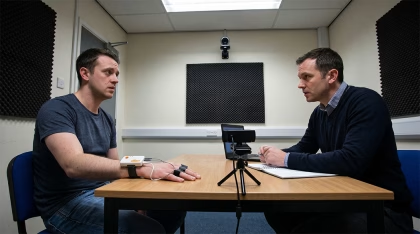
Forensic Science: Leveraging Human Behavior Research to Go Beyond the Crime Scene