



Explore the top five eye-tracking study designs for dyslexia research, highlighting innovative methodologies that enhance understanding of reading difficulties. These approaches provide valuable insights into cognitive processes and contribute to effective interventions for dyslexia.
Table of Contents
Eye tracking is especially valuable in dyslexia research because it captures processing effort and fluency directly, not just reading outcomes. However, the insights you get depend heavily on study design. Below are five core types of eye-tracking studies, each paired with methodological choices that make the data interpretable and reproducible.
But first, we start out with going over some of the best practices for reading research in general, before we jump into dyslexia studies specifically.
5 Best Practices for General Reading Research Design
Regardless of method or population, effective reading research is grounded in a set of core design principles that shape the validity and interpretability of results.
- Define the reading process before selecting a population
- Reading involves multiple cognitive operations, including visual encoding, word recognition, syntactic processing, and discourse comprehension. Clearly specifying which process is under investigation is a prerequisite for meaningful study design, particularly when working with developmental or clinical populations.
- Control all stimulus variables except the one being manipulated:
- Reading behavior is highly sensitive to stimulus properties such as word length, frequency, syntax, typography, spacing, luminance, and contrast. Manipulating a single variable at a time helps ensure that observed effects can be attributed to the intended experimental factor rather than unintended confounds.
- Choose a unit of analysis that matches the research question:
- Word-level designs are best suited for studying decoding and lexical access, sentence-level designs for syntactic integration, and paragraph-level texts for comprehension and reading strategies over time. Mixing units within a single study can introduce ambiguity by engaging different cognitive processes.
- Separate processing effort from performance outcomes:
- Measures such as reading speed or comprehension accuracy reflect outcomes, not the cognitive cost of achieving them. Similar performance can mask substantial differences in effort or strategy, making it important to interpret outcomes in the context of processing measures.
- Establish a normative baseline before studying atypical readers:
- Tasks, stimuli, and metrics should first be validated in typical readers to understand their behavior under standard conditions. This baseline is essential for interpreting differences observed in atypical or clinical populations and for avoiding misattribution of effects to population characteristics rather than task design.
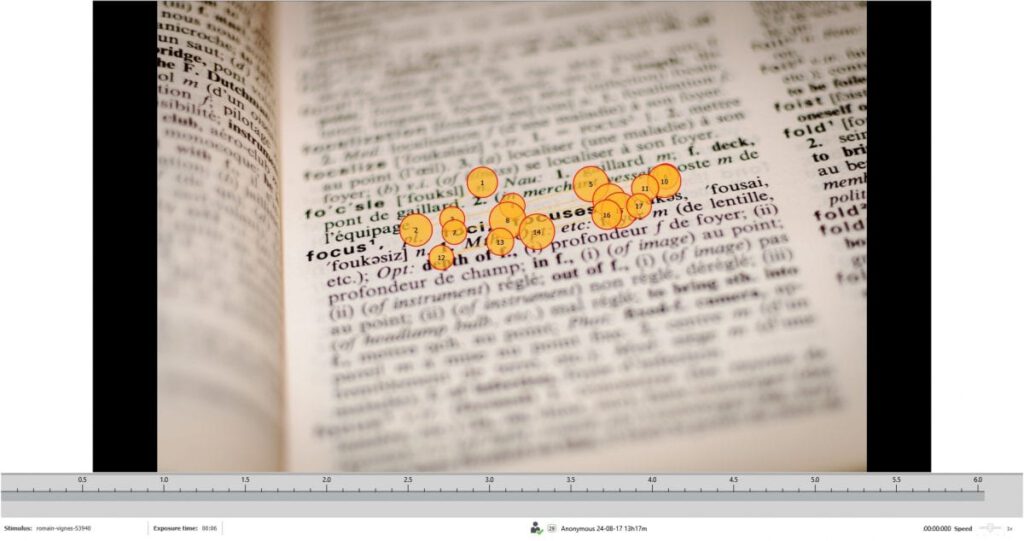
1. Controlled Reading Paradigm Studies
Goal: Isolate specific sources of decoding and linguistic difficulty.
Participants read carefully controlled text while eye movements are recorded. Only one or two variables are manipulated at a time, such as word frequency or orthographic complexity.
Methodological considerations
- Stimulus control
- Match sentences for length, syntax, and semantic predictability
- Manipulate one variable per condition (e.g. high vs low frequency words)
- Presentation
- Use line-by-line or paragraph formats consistently
- Avoid scrolling unless it is part of the research question
- Analysis focus
- Define word-level or region-level AOIs
- Separate first-pass reading from re-reading
Best-fit metrics
- Mean fixation duration per word
- First-pass reading time
- Revisits to a work or manipulation
- Regression probability
Why it works for dyslexia research: This methodology cleanly separates decoding difficulty from higher-level comprehension demands.
2. Comparative Group Studies (Dyslexic vs Control Readers)
Goal: Identify differences in reading strategies, not just speed or accuracy.
Two or more groups perform identical reading tasks under the same conditions. Groups are matched on age, education, and language proficiency.
Methodological considerations
- Participant matching
- Match on non-verbal IQ and vocabulary where possible
- Collect standardized reading scores for covariate analysis
- Statistical modeling
- Use mixed-effects models to account for individual variability
Best-fit metrics
- Fixation duration variability
- Saccade amplitude distributions
- Scanpath entropy or stability measures
Why it works for dyslexia research: Differences often appear in variability and strategy, not just in mean performance alone.
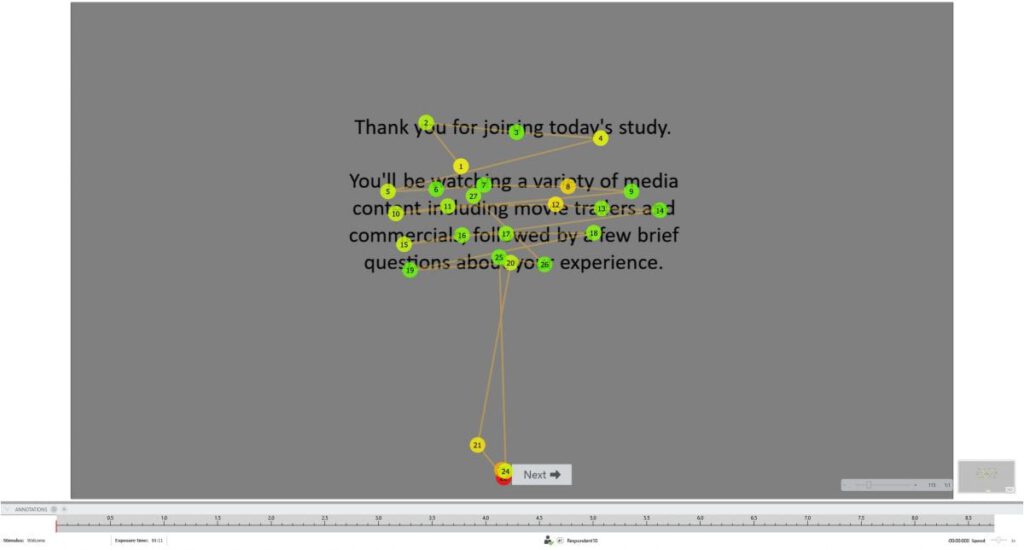
3. Typography and Layout Evaluation Studies
Goal: Measure how design choices influence reading effort.
Participants read the same text presented in different visual formats, such as font type, spacing, or line length.
Methodological considerations
- Study design choice (within- vs between-subject)
- A within-subject design can be used to reduce between-participant variability, as each participant is exposed to multiple layouts. When using this approach, presentation order should be counterbalanced to mitigate learning and repetition effects.
- A between-subject design may be preferable when repetition effects are likely to influence reading behavior, or when exposure to multiple layouts could bias strategy or expectation. This approach avoids carryover effects but requires larger sample sizes to account for individual variability.
- Visual control (true for all reading studies)
- Keep luminance and contrast constant across conditions
- Avoid decorative fonts unless explicitly testing them
- ROI definition
- Line-level or paragraph-level AOIs often provide more stable measures than word-level AOIs in layout and typography studies
Best-fit metrics
- Fixation density per line
- Regression density
- Pupil dilation relative to baseline
Why it works for dyslexia research: It captures effort differences even when comprehension scores remain unchanged.
4. Task-Demand Manipulation Studies
Goal: Separate decoding effort from instruction-driven cognitive load.
The text stays constant, but the task changes. For example, participants read for comprehension in one condition and for error detection in another.
Methodological considerations
- Task clarity
- Ensure instructions are unambiguous and practiced beforehand
- Ensure instructions are unambiguous and practiced beforehand
- Temporal alignment
- Time-lock eye-tracking data to task phases or prompts
- Time-lock eye-tracking data to task phases or prompts
- Control conditions
- Include a low-load baseline task for comparison
Best-fit metrics
- Temporal irregularity in fixation patterns
- Task-evoked pupil dilation
- Shifts in regression timing rather than frequency
Why it works for dyslexia research: It reveals whether increased load comes from decoding, task demands, or both.

5. Longitudinal and Intervention Studies
Goal: Track changes in cognitive load over time.
Eye tracking is collected across multiple sessions, often before and after an intervention such as reading training or assistive technology use.
Methodological considerations
- Session consistency
- Keep hardware setup, calibration procedure, and lighting identical
- Keep hardware setup, calibration procedure, and lighting identical
- Practice effects
- Use parallel text versions rather than repeated passages
- Use parallel text versions rather than repeated passages
- Change modeling
- Analyze trends within participants rather than group means alone
Best-fit metrics
- Reduction in fixation duration over time
- Decrease in regression frequency
- Stabilization of pupil responses
Why it works for dyslexia research: It captures improvements in effort even when reading speed changes slowly.