

Summary & Key Takeaways
GSR (Galvanic Skin Response) also known as EDA (Electrodermal Activity), measures changes in skin conductance driven by eccrine sweat gland activity, controlled by the sympathetic nervous system.
In iMotions, GSR/EDA is collected via integrations with Shimmer, BIOPAC, and PLUX Biosignals, with full time synchronization across multimodal data streams.
The signal is decomposed into:
- SCL (Skin Conductance Level) → tonic baseline arousal
- SCR (Skin Conductance Response) → phasic event-related peaks
Key computed metrics include:
- SCR peak count (event-related responses)
- Peak amplitude (response intensity)
- Rise time (activation speed)
- Half-recovery time (return to baseline)
iMotions automatically processes EDA data using R Notebooks, including:
- Signal filtering (e.g., Butterworth)
- Tonic/phasic decomposition
- Peak detection and event alignment
GSR/EDA is a validated measure of emotional arousal intensity, but:
- It does NOT measure emotional valence (positive vs negative)
EDA is widely used in:
- Psychophysiology research
- Neuromarketing and advertising testing
- UX and human factors research
- Clinical and VR-based studies
Table of Contents

1. What Is GSR/EDA in iMotions?
Galvanic skin response (GSR), also known as electrodermal activity (EDA), is defined as the variable electrical conductance of the skin surface, reflecting changes in eccrine sweat gland activity driven by the sympathetic nervous system.
While EDA is the current scientific standard term, GSR remains widely used in industry and applied research contexts. Additional related terms include skin conductance response (SCR), skin conductance level (SCL), electrodermal response (EDR), and psychogalvanic reflex (PGR). In iMotions, the module is labeled as EDA/GSR to accommodate both conventions.
GSR is measured by applying a small, constant, imperceptible voltage to two electrodes placed on the skin surface (typically the palm side of the fingers or the palm itself), and measuring the resulting electrical conductance in microsiemens (μS).
As sympathetic nervous system activity increases—due to emotionally relevant, startling, threatening, or cognitively demanding stimuli—eccrine sweat glands increase their output. This change alters the electrical properties of the skin, producing a measurable increase in conductance.
GSR is classified as a measure of emotional arousal, defined as the intensity dimension of emotional experience (how strongly activated a person is), independent of valence (whether the experience is positive or negative). A loud noise, an exciting reward, an aversive image, and a sexually relevant stimulus can all produce comparable GSR responses.
For this reason, GSR should not be used as a standalone measure of emotion but is highly informative when combined with valence-sensitive measures (e.g., facial expression analysis, self-report, or ECG-derived metrics).
2. Theoretical Foundation: Sympathetic Nervous System and Sweat Gland Activity
The eccrine sweat glands of the palmar and plantar surfaces of the hands and feet are innervated exclusively by the sympathetic branch of the autonomic nervous system. Unlike other physiological measures that reflect both sympathetic and parasympathetic regulation (such as heart rate), GSR is a pure sympathetic nervous system measure. When sympathetic activation increases—during emotional arousal, stress, cognitive effort, or attention-demanding events—eccrine sweat gland activity increases, elevating skin conductance.
GSR reflects two distinct overlapping components:
- Skin Conductance Level (SCL): The tonic, slowly changing baseline component of the GSR signal. SCL reflects overall autonomic arousal over extended periods (minutes to hours) and varies with hydration, skin temperature, and sustained emotional states. It is relatively stable within a session and is most useful for detecting prolonged arousal.
- Skin Conductance Response (SCR): The phasic, rapidly changing component of GSR that reflects brief bursts of sympathetic activation in response to specific events. SCRs appear as peaks superimposed on the SCL baseline. When an SCR occurs within ~1–5 seconds after a stimulus, it is classified as an Event-Related SCR (ER-SCR). Spontaneous peaks without identifiable triggers are classified as Non-Specific SCRs (NS-SCRs) and typically occur 1–3 times per minute.
3. How GSR Works in iMotions: Step-by-Step Pipeline
Step 1: Electrode Placement and Device Setup
GSR electrodes are attached to the palmar surface of two fingers (typically index and middle fingers) of the non-dominant hand, using Ag/AgCl electrode discs with isotonic gel or dry electrodes depending on the device. Consistent placement reduces variability. Participants should remain still to minimize motion artifacts.
Step 2: Signal Streaming and Visualization
The GSR device streams continuous skin conductance data to iMotions Lab in real time. Researchers monitor the live signal to ensure baseline stability and low artifact levels.
Step 3: Stimulus Presentation and Timestamp Synchronization
GSR recording runs concurrently with stimulus presentation. Event markers are embedded in the signal timeline, enabling identification of stimulus-linked SCRs during analysis.
Step 4: R Notebook Signal Processing
The iMotions GSR R Notebook automates:
- Signal quality assessment
- Low-pass Butterworth filtering (~5 Hz)
- Decomposition into tonic (SCL) and phasic (SCR) components
- Peak detection (e.g., >0.01 μS threshold)
- Calculation of amplitude, rise time, and half-recovery time
It also supports epoching, aggregating responses within defined time windows relative to stimuli.
Step 5: Data Export
Exported outputs include raw GSR signal, SCL, SCR, detected peaks (timestamps, amplitude, rise time, recovery time), and event markers in CSV format.
4. Supported Hardware
Shimmer Research
The Shimmer3 GSR+ is a compact, wearable, wireless GSR sensor integrated natively with iMotions. The Shimmer3 GSR+ supports both lab-based and ambulatory GSR recording, connecting to iMotions via Bluetooth. It is among the most widely used GSR devices in iMotions-based research.
BIOPAC Systems
BIOPAC GSR modules (GSR100C amplifier, Bionomadix wireless GSR system) provide research-grade, wired and wireless GSR recording integrated with iMotions. BIOPAC lab-grade systems are commonly used as the reference standard for GSR signal fidelity in controlled laboratory studies.
PLUX Biosignals
The biosignalsplux GSR sensor is integrated with iMotions and designed for both academic and clinical GSR measurement. The PLUX sensor uses low-noise signal conditioning optimized for detecting even low-amplitude SCR events.
GSR/EDA Hardware Selection
5. Key Metrics and Outputs
Raw GSR Signal
The raw GSR signal is defined as the unprocessed, continuous skin conductance time-series measured in microsiemens (μS). The raw signal contains both the tonic SCL baseline and superimposed phasic SCR components and serves as the input for all downstream decomposition and peak analysis.
Skin Conductance Level (SCL)
SCL is the tonic component extracted from the raw GSR signal after removal of phasic SCR contributions. SCL is used as an index of sustained autonomic arousal over extended time periods and for baseline comparisons between experimental conditions.
GSR Peak Count
GSR peak count is defined as the number of discrete SCR peaks detected within a defined time interval. Peak count is a commonly used GSR summary metric in event-related experimental designs, where the number of peaks per stimulus condition provides a measure of how many arousal responses a stimulus category elicited.
Peak Amplitude
Peak amplitude is defined as the difference in μS between the onset of an SCR peak (trough value before the rise) and the peak maximum. Higher peak amplitude indicates a stronger sympathetic arousal response to the preceding stimulus.
Peak Rise Time
Peak rise time is defined as the duration in seconds from peak onset to peak maximum. Rise time reflects the speed of the sympathetic activation response.
Peak Half-Recovery Time
Peak half-recovery time is defined as the duration in seconds from peak maximum to the point at which the signal has returned to halfway between the maximum and the pre-peak baseline. Half-recovery time reflects the speed of sympathetic deactivation after an arousal event.
6. Integration with Other Modalities
GSR + Facial Expression Analysis (FEA):
GSR captures the intensity of autonomic arousal (how much the person is activated) without indicating valence (positive or negative). FEA captures the emotional valence of visible facial expressions. The combination of GSR-based arousal and FEA-derived valence—within iMotions’ unified timeline—enables construction of a two-dimensional affective state consistent with the circumplex model of affect (Russell, 1980). This is one of the most common multimodal pairings in iMotions research.
GSR + Eye Tracking:
Eye tracking provides continuous gaze data indicating where a participant is looking, while GSR provides moment-by-moment arousal data. The combination allows researchers to identify which specific visual elements are driving arousal responses, enabling precise stimulus-linked analysis of emotional engagement alongside attentional behavior.
GSR + EEG:
GSR measures peripheral sympathetic arousal, while EEG measures cortical electrical activity related to cognitive and emotional processing. These signals are physiologically distinct and complementary: GSR captures the intensity and timing of autonomic arousal responses, while EEG reflects the underlying neural processes. This combination is widely used in emotion regulation research, decision-making studies, and neuromarketing.
GSR + ECG:
Both GSR and ECG reflect autonomic nervous system activity. GSR is a pure sympathetic measure (sweat gland activity), while ECG reflects combined sympathetic and parasympathetic cardiac regulation. Collecting both simultaneously in iMotions provides a more complete picture of autonomic balance and arousal dynamics than either signal alone.
GSR + Voice Analysis:
Voice analysis captures acoustic correlates of arousal and emotional expression in speech, while GSR captures the physiological arousal underlying those vocal changes. This combination supports research on vocal emotion authenticity, deception detection, and clinical assessments of emotional expression concordance.
7. Use Cases by Industry and Research Domain
Market Research and Advertising: GSR/EDA in iMotions is one of the most commonly used metrics in advertising and content testing. GSR peaks indicate moments in advertisements, retail environments, or product interactions that produce significant arousal responses. GSR is used to identify emotionally engaging moments, evaluate the impact of creative elements, and compare consumer responses across stimulus variants.
UX Research and Product Testing: UX researchers use GSR/EDA to measure arousal and stress during user interface interactions, website navigation, and product usability testing. Elevated GSR activity during task performance identifies frustrating, confusing, or highly engaging interaction moments that participants may not verbalize or accurately self-report.
Academic Psychology and Psychophysiology: Academic researchers use GSR/EDA as a standard measure of sympathetic arousal in studies of fear conditioning, attention, cognitive load, stress, emotion regulation, and clinical psychopathology. GSR has a long validated history in psychophysiology research dating to the mid-19th century and is one of the most-studied physiological arousal measures in the field.
Clinical Research: Clinical researchers use GSR in iMotions to assess autonomic dysregulation in populations with anxiety disorders, PTSD, schizophrenia, and autism spectrum disorder — conditions associated with altered electrodermal lability or stability. GSR provides a non-verbal, non-intrusive index of autonomic reactivity suitable for clinical populations with limited verbal self-report capability.
Human Factors and Safety Research: Human factors researchers use GSR to measure workload, stress, and arousal in safety-critical operational environments. In simulator studies (driving, aviation, industrial control), GSR identifies task conditions or environmental events that produce elevated sympathetic activation, indicating heightened operator stress or arousal.
VR Research: GSR/EDA is frequently combined with VR in iMotions research to measure physiological arousal during immersive virtual environments. Because VR environments can elicit strong emotional responses while participants are physically stationary, GSR provides a sensitive index of emotional engagement with virtual content.
8. Advantages Over Alternative Methods
GSR Compared to Self-Report Arousal Scales: Self-report arousal scales require conscious access to internal state, verbal articulation of that state, and honest reporting. GSR provides a continuous, non-intrusive, objective measure of sympathetic arousal that does not require participant effort or verbal capability, is not subject to social desirability bias, and captures arousal responses in real time rather than retrospectively.
GSR Compared to Cortisol: Salivary cortisol is a validated biomarker of hypothalamic-pituitary-adrenal stress responses but peaks 20–30 minutes after stress onset, cannot provide moment-to-moment arousal tracking, and requires sample collection procedures that interrupt study tasks. GSR provides continuous, real-time arousal tracking within the experimental session with no sample collection burden.
GSR Compared to Pupillometry: Pupil dilation (measured via eye tracking in iMotions) also reflects sympathetic nervous system activation and can serve as a proxy arousal measure in some contexts. Pupillometry requires an eye tracker and is affected by luminance changes that produce reflexive pupil responses independent of arousal state. GSR is not affected by visual stimulus luminance and provides a more direct and well-validated measure of sympathetic arousal.
9. Limitations and Considerations
GSR Measures Arousal, Not Valence The most important limitation of GSR as a standalone measure is that it reflects the intensity of emotional arousal without indicating whether the experience is positive or negative. A pleasant surprise and a frightening event may produce comparable GSR responses. GSR should always be paired with valence-sensitive measures in emotional research designs.
Habituation to Repeated Stimuli: GSR responses habituate — decline in amplitude and frequency — with repeated presentation of the same stimulus. Stimulus novelty is a primary driver of GSR peaks. In repeated-measures designs or studies requiring multiple presentations of the same stimulus type, habituation effects must be accounted for in the analysis.
Movement Artifact Susceptibility: Physical movement, including hand and arm movements, produces motion artifacts in the GSR signal. Participant instruction to remain still, combined with automated movement artifact flagging in the analysis, is required for valid GSR measurement. Wrist-based devices (Empatica E4) are more susceptible to movement artifacts than finger-based electrodes.
Inter-Individual and Demographic Variability: GSR amplitude and baseline SCL vary substantially across individuals due to differences in eccrine gland density, hydration, skin temperature, age, and medication use. Some individuals are classified as electrodermal labile (frequent spontaneous SCRs) and others as electrodermal stable (few spontaneous SCRs), a distinction with known genetic and clinical correlates. Between-participant comparisons of GSR amplitude require appropriate normalization or within-participant designs.
10. FAQ: EDA/GSR in iMotions
What does iMotions GSR measure?
iMotions GSR measures the electrical conductance of the skin surface, which changes in response to eccrine sweat gland activity driven by sympathetic nervous system activation. The module produces the raw GSR signal, tonic skin conductance level (SCL), phasic skin conductance responses (SCR), event-related peak counts, peak amplitude, rise time, and half-recovery time.
Is GSR the same as EDA?
Galvanic skin response (GSR) and electrodermal activity (EDA) refer to the same physiological phenomenon, which are changes in skin electrical conductance driven by sympathetic sweat gland activity. EDA is the current scientific standard term, while GSR is widely used in industry and applied research contexts. iMotions labels the module as EDA/GSR to accommodate both conventions.
Can GSR tell whether an emotional response is positive or negative?
GSR alone cannot distinguish positive from negative emotional responses. GSR measures the intensity of sympathetic arousal, not its valence. To determine whether an arousal response is positive or negative, GSR should be paired with a valence-sensitive measure such as Facial Expression Analysis (FEA), voice analysis, or self-report in iMotions.
Which hardware supports GSR/EDA in iMotions?
iMotions natively integrates GSR/EDA hardware from Shimmer Research (Shimmer3 GSR+), BIOPAC (GSR100C, Bionomadix wireless), and PLUX Biosignals. Hardware selection depends on study requirements for signal fidelity, wearability, ambulatory capability, and participant electrode tolerance.
What is GSR peak detection and how does iMotions perform it?
GSR peak detection is the automated identification of discrete phasic SCR events in the GSR signal. In iMotions, peak detection is performed via the GSR R Notebook, which applies the following steps: low-pass filtering of the phasic signal, identification of onset points (where the signal crosses above a threshold, typically >0.01 μS), and identification of offset points (where the signal crosses below a threshold, typically <0 μS). Each detected peak is characterized by its amplitude, rise time, and half-recovery time.
Further Multimodal Reading
- Facial Expression Analysis in iMotions: A Comprehensive Technical and Research Guide
- What is EDA peak detection and how does it work?
- What are R Notebooks in iMotions
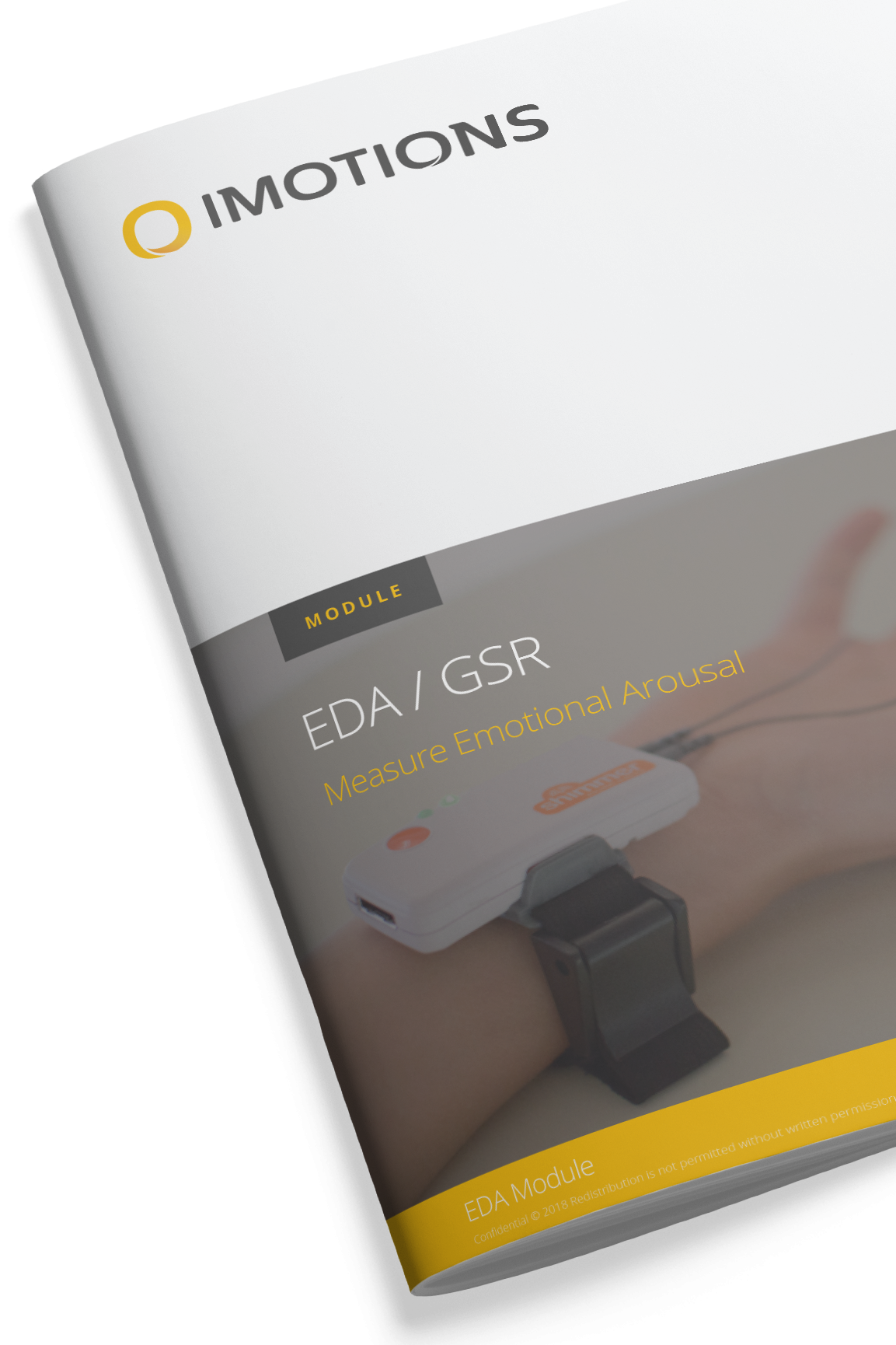
Free 36-page EDA/GSR Guide
For Beginners and Intermediates
- Get a thorough understanding of all aspects
- Valuable GSR research insights
- Learn how to take your research to the next level
References
- Boucsein, W. (2012). Electrodermal ahttps://psycnet.apa.org/record/2012-00422-000ctivity (2nd ed.). Springer.
- Dawson, M. E., Schell, A. M., & Filion, D. L. (2007). The electrodermal system. In J. T. Cacioppo, L. G. Tassinary, & G. G. Berntson (Eds.), Handbook of psychophysiology (3rd ed., pp. 159–181). Cambridge University Press.
- Fowles, D. C., et al. (1981). Publication recommendations for electrodermal measurements. Psychophysiology, 18(3), 232–239.
- Russell, J. A. (1980). A circumplex model of affect. Journal of Personality and Social Psychology, 39(6), 1161–1178.
- Benedek, M., & Kaernbach, C. (2010). A continuous measure of phasic electrodermal activity. Journal of Neuroscience Methods, 190(1), 80–91.