
Multiface analysis in action explores advanced methods for studying facial expressions in dyads, focus groups, and audience testing to uncover group emotions and real-world interaction insights.
Table of Contents
Humans have evolved to give facial cues to one another. An important part of verbal and non-verbal language alike, facial expressions have intrigued researchers for centuries.
With advances in technology, we’ve gone from manually annotating the expressions to having machine learning algorithms tell us when an expression is observed through a simple camera. If this already feels normal, everyday research to you, it’s time to level up and study facial expressions in interactive and group settings – the very settings we evolved to display them in.
Studying Multiple Faces in Real-World Research Application Areas
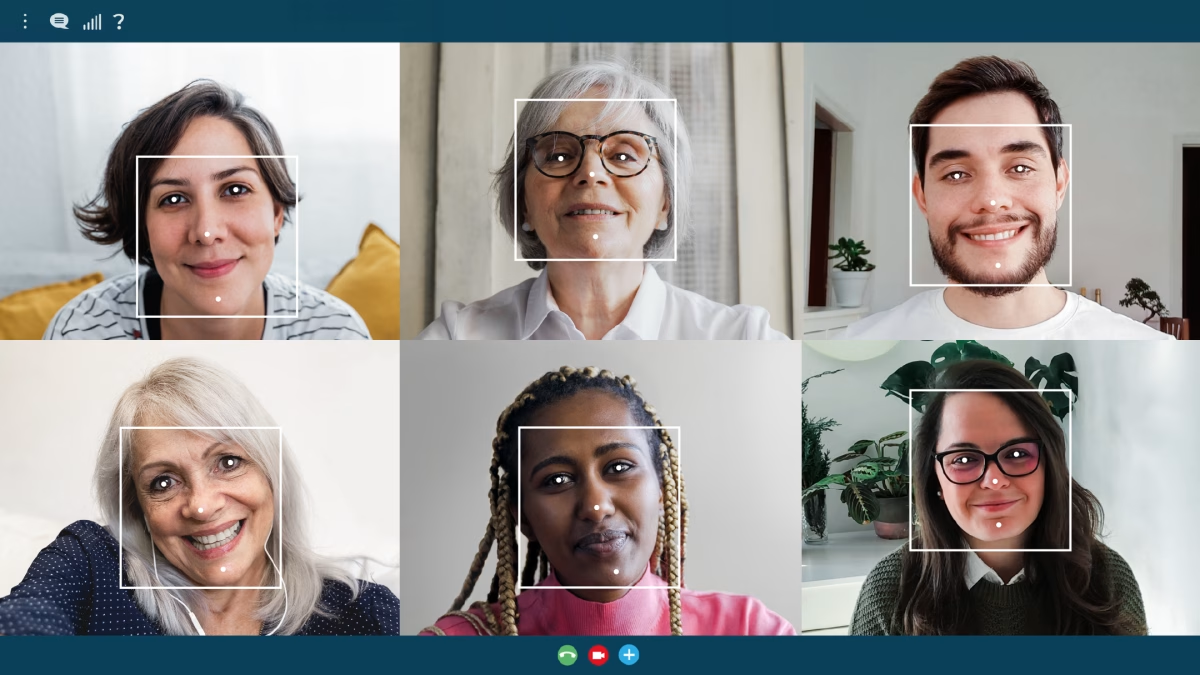
Researchers in communications, developmental psychology, product testing, training and performance, all want to study human interactions, or how we understand experiences in groups. Here are some common study types that leverage studying multiple people’s faces at once:
Dyadic interactions
In many research questions, it is important to know how people interact with each other. How do we talk about politics in a divided world, or how do we arrive at solutions in a cooperative environment; how do we give and receive feedback, and how do we reflect back emotions in a conversation.
These interactions can also be powerful dyads such as doctor-patient relationships or parent-child interactions enabling researchers to answer detailed questions on how relationships and prognosis develop in different settings.
All these questions require that we see the effect of one person’s expressed emotions on another person. This makes the study design more complex, but the insights that much more nuanced.
How to set up the study:
- In order to tease apart different segments of a conversation, consider clear topics of discussion. These can be guided by the researcher, or natural and free flowing from the participants view and annotated by the researcher based on qualitative information from conversations.
- A well-defined research question goes a long way, particularly in more naturalistic environments. This can not only help segment the data in meaningful ways, but also define subgroups based on demographics, group membership or communication styles.
- Faces alone only convey a part of how we communicate. Combining biosensors can give more powerful insights. Emotion detection from voice analysis or arousal metrics from skin conductance or heart rate can give another dimension to what happens in dyadic interactions and how our face, tone and physiology reacts to another person.
- To have a clean design, instruct participants to respect turn taking. This will allow researchers to mark a clear distinction between a person speaking and listening so these can be analysed separately.
- Leverage live markers and mark relevant points during live data collection for ease of annotations and segmentation during analysis.
Example study set up
- Imagine a study where you have two participants on opposing political views discussing a current issue. As already seen in the research question, it is important to have a clear topic of discussion. Segmenting this topic into themes will then be easier. Turn taking will allow analysis of each participant when certain pros and cons are presented as an argument. Researchers could also add manipulations such as presenting evidence on one side or another in the form of news clips or documentaries.
- Another example could be that of leadership training. This would be more free flowing where leaders are recorded in everyday situations. Here, the researchers could add live markers during data collection to mark periods of core communication tasks such as feedback given and if it was positive or negative, or qualitative markers from researchers pre-existing knowledge on good leadership tactics and when these were employed in situations.
Multiface Analysis in Focus Groups
When testing products, researchers typically want to study a group effect. How we use and evaluate a product, not just in isolation, but being influenced by other people’s thoughts and emotions. In this constellation, researchers are interested in individual and overall impressions towards the products. Which product had, in general, more positive experiences for the group, and which one has scope for improvements.

How to set up the study:
- It is best to have clearly defined segments with a guided or semi-guided interview to structure the interactions.
- To segment the focus group efficiently, have predefined parts to the test. For example a sensory product could be broken into testing first the package, then the smell and texture and finally the taste of the product.
- Again, since we communicate more than just from our expressed emotions, consider using voice analysis in focus group testing as well.
- As in the previous examples, encourage people to not talk over each other for cleaner analysis.
- As in the previous examples, leverage live markers and mark relevant points during live data collection for ease of annotations and segmentation during analysis.
Example study set up
Taking the same sensory example mentioned above, researchers could structure the focus group into guiding the participants into first the package, then the smell and texture and finally the taste of the product.
Each of these segments can be marked up by researchers by pressing a preset key associated with the segment. Within each segment, it is important to have a semi-structured interview that encourages participants to reflect and talk about various aspects of the product.
In other words, researchers should go beyond just asking people very vague open ended questions like ‘what do you think of the product’ or questions that can hinder more verbalisation like ‘do you like the product’.
It would be better to ask questions on variables of interest such as colour, smoothness, flavour profile etc. This will allow easier segmentation of the focus group session at analysis, allowing researchers to have more straightforward results.
Multiface Analysis in Audience testing
Often we want to know how a larger group of people feel towards a group experience such as movies or exhibitions. In this case, the interaction may not be conscious, but it is still a group experience. Researchers would want to know how most people react and how groups of people experience feelings, intensifying the experience for everyone in the space.
How to set up the study:
- If the research required knowledge of every individual’s facial expressions, it is important that everyone stay in the same position, such as seated in the same seats in a living room watching a movie.
- If it is important for the study design to have ecological validity and people come and go in front of the screen or scene of interest and researchers want to capture what is happening at any given point in time in a more dynamic setup, it is important to rather focus on aggregated emotions of all faces detected.
Example study set up
Let’s take a film testing example, where a group of people are seated in a living room like setup, with everyone facing the screen and therefore the camera. Best practices would involve predetermining which parts of the film we are interested in testing and studying emotional reactivity to these scenes.
Researchers could analyse group trends in those predefined segments areas, or do a more data driven analysis, looking at any areas where certain emotions like joy or surprise peaked to in turn understand what was happening in the movie when the group expressed said emotions. At an individual level, if some individuals stand out, they can be used for a post-test interview to understand sub-groups in the audience.
Conclusion
Facial expressions have always been central to how humans connect and communicate. What has changed is our ability to measure and interpret them in dynamic, real-world settings. By studying multiple faces at once, researchers can move beyond isolated reactions and gain deeper insight into emotional exchange, group dynamics, and shared experiences.
Whether in dyadic conversations, focus groups, or audience testing, thoughtful study design is key. Clear segmentation, structured turn taking, live markers, and complementary tools like voice or physiological analysis help transform complex interactions into meaningful data.
As research shifts toward more naturalistic environments, analyzing multiple faces simultaneously becomes essential. Humans did not evolve to emote alone – and understanding how emotions move through groups allows us to better understand the social world itself.
Frequently Asked Questions (FAQ)
1. What is multiface analysis in action?
Multiface analysis in action refers to the advanced study of multiple individuals’ facial expressions simultaneously in interactive group settings such as dyads, focus groups, and audience testing.
Unlike traditional single-subject emotion research, this method captures emotional exchange between people in real time. It allows researchers to understand how emotions spread, synchronize, or diverge within a group, providing deeper insights into communication and shared experiences.
To harness these capabilities and unlock the full potential of group emotion analysis in your research, explore the advanced features of our dedicated Multiface Module.
2. How is multiface analysis used in dyadic interaction research?
In dyadic research, such as doctor–patient conversations, political debates, or leadership feedback sessions, multiface analysis in action helps track how one person’s facial expressions influence another’s emotional response.
Researchers can segment conversations into speaking and listening phases, mark key discussion topics, and analyze emotional reactions to specific arguments. This structured approach reveals patterns of empathy, tension, cooperation, or conflict in interpersonal communication.
3. Why is multiface analysis valuable in focus groups and product testing?
Multiface analysis in action enhances focus group research by measuring both individual and group-level emotional reactions to products or services.
By structuring sessions into predefined segments (such as packaging, scent, texture, or taste), researchers can pinpoint exactly which product features trigger positive or negative emotional responses. This reduces reliance on self-reported feedback and provides objective emotional data for clearer decision-making.
4. How should researchers structure a multiface study for clean 4. Can multiface analysis be applied to audience testing?
Yes. Audience testing is one of the most impactful applications of multiface analysis in action.
Researchers can measure aggregated emotional responses during movies, exhibitions, or live events. By analyzing emotional peaks – such as joy, surprise, or confusion – they can identify which moments resonated most strongly with viewers. This helps improve storytelling, engagement strategies, and overall audience experience design.
5. What technologies support multiface analysis in action?
Modern multiface analysis relies on advanced technologies including:
- AI-based facial expression recognition
- High-resolution camera tracking systems
- Voice tone and speech analysis tools
- Biosensors measuring heart rate and skin conductance
- Live event markers for accurate segmentation
When combined, these tools create a multidimensional view of emotional interaction, offering richer insights into how people communicate in real-world group environments.