



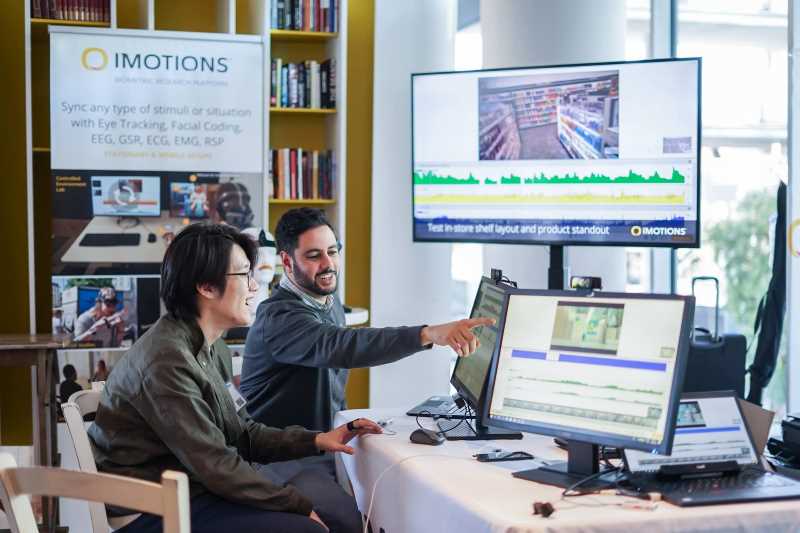
Abstract: In this paper, we aim to predict students’ learning performance by combining two-modality sensing variables, namely eye tracking that monitors learners’ eye movements and electroencephalography (EEG) that measures learners’ cerebral activity. Our long-term goal is to use both data to provide appropriate adaptive assistance for students to enhance their learning experience and optimize their performance. An experimental study was conducted in order to collet gaze data and brainwave signals of fifteen students during an interaction with a virtual learning environment. Different classification algorithms were used to discriminate between two groups of learners: students who successfully resolve the problem-solving tasks and students who do not. Experimental results demonstrated that the K-Nearest Neighbor classifier achieved good accuracy when combining both eye movement and EEG features compared to using solely eye movement or EEG.
Related Posts
-
The Brain’s Buy Button Is a Myth
-
How to Study Indoor Wayfinding: What People Notice, Where They Struggle, and What to Measure
-

Combatting Fraud in Online Surveys: What To Do When Your Respondents Aren’t Real
-
Human-in-the-Loop Digital Twins: How Real-Time Biosensor Data Is Transforming Simulator Research